After years of operating inside multinational organizations, I have learned one hard truth: running a complex global business without robust performance reporting and forecasting systems is effectively flying blind. Data flows constantly from regions, business units, and functions but without a structured reporting framework, that data never becomes decision-grade insight.
Equally important is the ability to look forward. Historical reporting alone does not protect enterprise value. Forward-looking financial forecasting is what allows leadership teams to anticipate risks, allocate capital intelligently, and course-correct before problems surface in the P&L or cash flow. Together, performance reporting and forecasting function as a financial dashboard and GPS showing where the business stands today and where it is headed tomorrow.
When these systems are weak or fragmented, the consequences are real. Missed growth opportunities, delayed responses to market shifts, and liquidity surprises are common failure modes. Poor cash flow visibility alone is cited as a contributing factor in over 80% of business failures. For global enterprises operating across markets, currencies, and regulatory regimes, the margin for error is thin.
I, Sumedh Deo, with this article examines why performance reporting and forecasting matter in global businesses, the challenges multinational organizations face in building them, and the best practices CFOs rely on to create systems that support disciplined execution and long-term value creation.
Why Performance Reporting and Forecasting Matter in Global Business
What Performance Reporting Really Means
At its core, performance reporting answers a simple but critical question: Are we executing against strategy? It is the structured communication of financial and operational performance using relevant, decision-oriented metrics.
In practice, effective performance reporting systems combine:
- Financial KPIs such as revenue growth, margin performance, and cash conversion
- Operational indicators including efficiency, productivity, and customer outcomes
- Clear alignment with strategic objectives rather than isolated functional metrics
Modern FP&A functions no longer treat reporting as a backward-looking compliance exercise. According to Gartner, management reporting, forecasting, and modeling are now core components of strategic finance linking planning to execution and enabling leadership teams to act with confidence.
Well-designed reporting does not overwhelm executives with data. It highlights variances, explains drivers, and clarifies where intervention is required. The goal is not visibility for its own sake, but governed insight that supports faster, better decisions.
The Role of Forecasting in Global Finance
If performance reporting tells you where the business is, financial forecasting estimates where it is going. Forecasting uses historical data, current trends, and informed assumptions to project revenues, costs, cash flows, and balance sheet outcomes.
For CFOs, forecasting is a risk management and capital allocation tool. It supports decisions around:
- Hiring and workforce planning
- Capital investments and divestments
- Liquidity management and funding strategies
- Scenario planning under volatile market conditions
In global organizations, forecasting also creates a single forward-looking view of the enterprise. It integrates inputs from diverse geographies, accounts for currency exposure, and reflects regional market dynamics within a consolidated outlook. This is essential for coordinating strategy across borders and ensuring leadership is aligned on expectations.
Forecasting credibility matters externally as well. Investors and boards expect finance leaders to demonstrate not only control over historical performance, but a clear and defensible view of future outcomes.
Why These Systems Are Critical for Global Enterprises
Multinational businesses operate in an environment of structural complexity, multiple subsidiaries, regulatory frameworks, reporting standards, and economic conditions. Performance reporting systems distill that complexity into actionable insight.
Internally, they create transparency and accountability. Regular, consistent reporting aligns teams around shared targets and enables leadership to track progress across regions and functions. Externally, they support governance, compliance, and stakeholder confidence.
Strong reporting also elevates the quality of conversation. As one CFO put it bluntly: “There is little value in reporting the past unless it improves the future.” High-quality reporting explains why results occurred and what actions should follow.
Forecasting plays a complementary role. In volatile environments, whether during economic downturns, geopolitical disruption, or supply chain shocks, companies with agile forecasting capabilities respond proactively rather than reactively. During the COVID-19 pandemic, for example, organizations that implemented dynamic forecasting models and cross-functional data integration were better positioned to manage liquidity, demand shocks, and operational disruption.
Together, performance reporting and forecasting form the twin engines of strategic finance: one providing clarity on current execution, the other enabling informed navigation of what lies ahead.
A Strategic Priority for High-Performing Organizations
It is no coincidence that leading global companies invest heavily in these capabilities. Nearly half of large enterprises use structured frameworks such as the Balanced Scorecard, combining financial and non-financial metrics to monitor performance against strategy.
CFOs consistently rank forecast accuracy, agility, and insight quality among their top priorities. Reliable forecasts inform decisions far beyond finance from supply chain planning to pricing strategy and workforce investments.
The takeaway is clear. In today’s interconnected and volatile business environment, global organizations cannot rely on fragmented reports or static forecasts. They need integrated, governed systems that provide a clear view of performance today and a credible projection of tomorrow.
For complex global businesses, strong performance reporting and forecasting systems are not optional infrastructure; they are core enablers of strategic control and sustainable growth.
Challenges in Building Reporting and Forecasting Systems for Global Enterprises
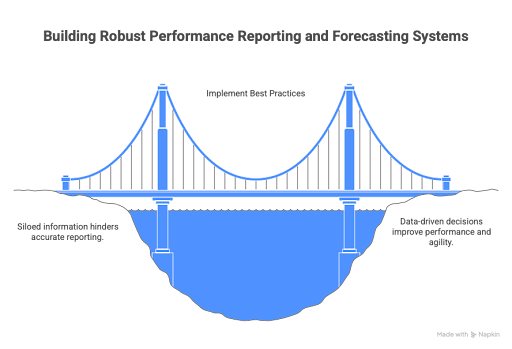
Implementing performance reporting and forecasting in a complex global business looks straightforward on paper. In practice, it is one of the hardest operational disciplines to get right and I say that after years of overseeing finance organizations across regions, currencies, and regulatory regimes. The challenges are structural, cultural, and strategic, not merely technical.
Data Silos and Inconsistencies
In most multinational organizations, data fragmentation is the default state. Different regions run different ERP systems, CRM platforms, and local tools, often layered with spreadsheets built to compensate for system gaps. The result is a reporting environment that consumes enormous effort yet delivers limited confidence.
Fragmented finance processes increase manual intervention, introduce reconciliation risk, and inflate operating cost. From a governance standpoint, this is dangerous. When there is no credible single source of truth, leadership discussions drift toward debating whose numbers are right instead of focusing on what the numbers are telling us. As a CFO, I view this as a failure of enterprise performance management, not a reporting inconvenience.
Varied Regional Conditions and Forecast Complexity
Global forecasting breaks down quickly when regional realities are ignored or inconsistently modeled. Exchange rate volatility alone can materially distort consolidated results, affecting earnings visibility and capital allocation decisions. Add divergent local assumptions, regulatory constraints, and market maturity levels, and uniform forecasting becomes fragile.
It is not surprising that many finance teams struggle to forecast beyond six months. When forecasts take weeks to finalize, they lose relevance for executive decision-making. In my experience, this is a signal that traditional forecasting models are misaligned with the pace and uncertainty of the business environment.
Volume of Data and Reporting Clamor
Global organizations generate vast amounts of performance data. The risk is not scarcity, it is excess. Too many finance teams produce exhaustive monthly reporting packs that create the illusion of control while obscuring insight.
Low-value and redundant reports dilute attention away from the handful of KPIs that actually drive outcomes. Data without prioritization becomes clamor. More information does not improve decision quality unless it is curated, contextualized, and tied directly to strategic and financial levers.
Lack of Insight and Actionability
Even well-structured reports often fail where it matters most: interpretation. Senior leaders see variances but lack clarity on drivers, implications, and trade-offs. A variance without narrative is an accounting artifact, not a management tool.
Effective performance reporting must connect numbers to cause and consequence. When reports do not provoke discussion about corrective action, resource reallocation, or risk mitigation, they are not serving their purpose. In my view, this is where finance earns or loses its seat at the table.
Process and Cultural Barriers
Finally, transformation efforts often underestimate the human dimension. Standardizing metrics, definitions, and forecasting processes requires change management, not just systems integration. Teams are understandably attached to familiar tools and local practices.
Equally important is capability building. Advanced forecasting, analytics, and scenario modeling demand new skills and a culture that values data-driven decision-making. Without alignment between finance and operations, even the most sophisticated FP&A platform will underperform. The toughest work is rarely technical; it is behavioral.
Despite these challenges, they are solvable. Strong performance reporting and forecasting systems are built deliberately, over time, with discipline and leadership commitment. What follows are best practices that I have seen work consistently in global organizations.
Best Practices for Building Performance Reporting and Forecasting Systems
Designing a robust performance reporting and forecasting framework is not a one-off initiative. It is an evolving management system that must scale with the business. Certain principles, however, form a reliable foundation.
1. Define Clear KPIs Aligned to Strategy
Start with strategic clarity. Every KPI should exist for a reason and trace directly back to enterprise objectives. Financial metrics such as revenue growth, EBITDA, and cash flow remain essential, but they are lagging indicators.
High-performing finance teams also track leading operational and market metrics, customer acquisition cost, capacity utilization, quality measures, and market share that influence future financial performance. Frameworks like the Balanced Scorecard can help maintain balance, but discipline matters more than methodology.
The test is simple: does this metric inform decision-making? Each KPI should have ownership, targets, and consequences. Reporting without accountability is theater.
2. Establish a Single Source of Truth Through Data Integration
Data integration is non-negotiable. Consolidating information across subsidiaries, systems, and functions into a unified platform is foundational to reliable forecasting and performance management.
Modern enterprise performance management and FP&A platforms enable automated consolidation, standardized currency conversion, and consistent application of accounting policies. The efficiency gains are material, but the strategic benefit is greater: trust in the numbers.
When organizations replace fragmented legacy systems with an integrated solution, they reduce error risk, accelerate close cycles, and free finance capacity for analysis and judgment. From a CFO perspective, this directly improves governance, forecasting accuracy, and executive confidence.
3. Leverage Automation, Analytics, and Real-Time Reporting
Technology should absorb repetition so finance can focus on insight. Automated data ingestion, dashboard updates, and variance analysis allow reporting to shift from monthly retrospectives to near-real-time management tools.
Rolling forecasts, supported by automation, are particularly powerful. They enable organizations to look several quarters ahead on a continuous basis, adjusting assumptions as conditions change. Scenario modeling and advanced analytics further strengthen resilience by quantifying downside risk and opportunity exposure.
In my experience, when forecasting evolves from a static annual exercise into a dynamic decision-support system, leadership agility improves measurably. The return on investment shows up not just in time saved, but in better capital allocation, faster course correction, and reduced strategic risk.
4. Provide Insightful Narrative and Context
One lesson I have learned repeatedly is this: numbers alone do not drive decisions, interpretation does. A performance reporting system only becomes valuable when data is paired with insight, context, and clear implications for action.
Finance teams and business leaders must move beyond reporting variances to explaining why those variances occurred and what management intends to do about them. If revenue declines in Asia-Pacific, the question is not whether the number movedit is whether the movement reflects demand softness in a specific market, supply chain disruption, pricing pressure, or a one-off timing issue. Each explanation carries a different strategic response and risk profile.
Effective performance reporting should tell a concise, decision-oriented story. Every report should explicitly answer three questions executives care about: What happened? Why did it happen? What do we do next? This narrative discipline transforms reporting from a retrospective exercise into a management control mechanism.
In practice, this means embedding brief written commentary or dashboard annotations that highlight key drivers, risks, and corrective actions. Training finance teams in driver-based analysis, breaking variances into volume, price, mix, and cost components dramatically improves insight quality. The purpose of reporting past performance is not historical accuracy alone; it is to shape better future outcomes.
5. Induce Cross-Functional Collaboration
Siloed reporting and forecasting rarely survive real-world volatility. The most resilient performance management systems are built collaboratively across finance, sales, operations, supply chain, and regional leadership.
Sales teams bring ground-level intelligence that strengthens revenue forecasts. Operations and procurement leaders surface cost pressures and capacity constraints before they hit the P&L. When forecasting assumptions are debated openly and validated cross-functionally, forecast credibility improves materially.
During periods of disruption particularly the volatility many organizations experienced between 2020 and 2021 cross-functional collaboration proved essential for rapid forecast recalibration. Forecasting must be treated as an enterprise planning process, not a finance-only deliverable.
This collaboration also improves performance reporting discipline. When functional leaders understand how their metrics roll into enterprise KPIs, accountability increases. Culturally, reinforcing shared ownership of outcomes rather than functional scorekeeping drives stronger engagement and better execution. An added benefit is improved data integrity, as cross-functional dialogue often exposes data quality issues that can be corrected at the source.
6. Embed a Data-Driven Culture and Continuous Improvement
No performance reporting or forecasting system is ever finished. High-performing finance organizations treat these systems as living management assets that evolve alongside the business.
A data-driven culture must be cultivated deliberately. This includes upskilling teams to interpret dashboards, challenge assumptions, and apply analytical thinking in day-to-day decisions. Organizations that consistently outperform peers rely less on instinct and more on structured analysis, reducing decision risk at scale.
Equally important is measuring the effectiveness of your own forecasts and reports. Track forecast accuracy over time, analyze where deviations occurred, and identify whether errors stemmed from external shocks or flawed assumptions. Misses should be treated as learning inputs, not failures. This feedback loop strengthens forecasting discipline and credibility.
Reporting itself should also be reviewed periodically. If reports are not being read, understood, or acted upon, they should be retired. Redundant reports create clamor. Solicit direct feedback from executives and business leaders on what information materially improves decision-making. Continuous refinement ensures the performance management system remains relevant as strategy, markets, and risk profiles evolve.
Over time, organizations may integrate new KPIs such as ESG, customer lifetime value, or operational resilience metrics or adopt advanced forecasting techniques, including predictive analytics and machine learning. The objective is not sophistication for its own sake, but improved foresight and decision quality.
When these practices are executed wellstrategic KPI alignment, integrated data, automation, insightful analysis, collaboration, and continuous learning global businesses convert complexity into strategic intelligence. The result is a measurable competitive advantage: faster response, better planning, and more confident execution.
As finance leaders often observe, strong forecasting is built on disciplined reporting. When you have clarity on where the business has been and where it stands today, navigating the road ahead becomes far more precise.
Conclusion
In an environment defined by global competition, volatility, and capital scrutiny, strong performance reporting and forecasting systems are no longer treated as a side project; they are mission-critical. They form the nervous system of a complex enterprise, converting raw data into insight and foresight. Book a call with me today and let’s talk finance transformation
Yes, building these capabilities requires investment in technology, rigor in metric design, and commitment to a data-driven culture. But the return on investment is substantial. With trustworthy performance reporting systems, leaders can identify risks and opportunities across regions quickly and confidently. With agile forecasting, they can allocate capital proactively rather than react defensively.
Organizations that excel in performance reporting and forecasting consistently outperform peers because they understand their position and can see what is coming next. The practical takeaway for any leadership team is to assess whether current reporting and planning processes provide the visibility, predictability, and decision support required at scale.
Even incremental improvements automating a critical report, introducing rolling forecasts, or strengthening narrative discipline compounded quickly. Building these capabilities is a journey, but once the reporting and forecasting engine is operating effectively, a global business is far better equipped to execute strategy with confidence and control.
FAQs
Q: What is a performance reporting system?
A performance reporting system is the framework through which an organization measures, consolidates, and communicates progress against strategic objectives. It combines defined KPIs, integrated data processes, and structured reports or dashboards to provide visibility into financial and operational performance.
Its purpose is to enable informed decision-making by highlighting results, risks, and deviations in a timely and comparable manner. Simply put, it is how leadership determines whether the business is winning and why.
Why are performance reporting systems important for global businesses?
For complex global organizations, performance reporting systems are essential for alignment, transparency, and governance. They provide a consistent, enterprise-wide view of performance across regions, business units, and markets.
This consistency allows leadership to compare results on an apples-to-apples basis, identify underperformance or opportunity early, and respond decisively. Without a robust reporting system, global businesses fragment each region operating on its own data, assumptions, and narrative. Strong reporting restores coherence, trust, and strategic control at scale.
Q: What is financial forecasting and why is it essential?
A: Financial forecasting is the process of predicting a company’s future financial outcomes such as revenue, expenses, profit, and cash flow based on analysis of historical data, current trends, and assumptions about the future. It is essential because it helps businesses plan ahead and make strategic decisions with foresight.
For example, forecasts inform how to allocate budgets, whether to expand to new markets, or when to cut costs. Good forecasting shines a light on potential risks (like an economic downturn or a supply shortage) so a company can prepare mitigating actions. It’s especially important for managing cash flow and investments.
Think of forecasting as a financial early warning system. In global companies, forecasting also includes scenario planning for different regions and consolidating those into a unified view. Essentially, while reporting looks backward, forecasting looks forward and both are needed to steer the business effectively.
Q: What challenges do companies face in forecasting and reporting globally?
A: Companies operating globally face a few common challenges in these areas. One big challenge is data inconsistency and silos different subsidiaries might use different systems or standards, making it hard to gather consistent data for reporting. Currency fluctuations are another headache; when exchange rates move, they can distort comparisons and forecasts across countries.
Additionally, global businesses deal with varied market conditions; each region’s unique economic and regulatory factors can make it difficult to create one accurate forecast for the whole company. There’s also the sheer volume of data in a large organization, which can lead to information overload or too many reports that obscure key insights.
Lastly, the process can be slow or complex, coordinating input from many teams worldwide often means forecasts take a long time to produce (one survey found almost 30% of companies need more than 10 days to finalize a forecast). Overcoming these challenges requires integrated systems, standardizing definitions, using automation, and introducing a collaborative planning culture.
Q: How can we improve forecasting accuracy for a global business?
A: Improving forecast accuracy in a global business involves several best practices.
First, invest in quality data and tools to ensure you have a centralized platform where all your financial and operational data comes together reliably, and consider modern FP&A software that can handle large data sets and automation.
Second, use a rolling forecast approach instead of only annual budgeting; updating forecasts frequently (monthly or quarterly) allows you to incorporate the latest information and adjust for changes, which boosts accuracy.
Third, incorporate a variety of inputs: go beyond basic financial trends and include operational metrics and external indicators (like sales pipeline data, economic indicators, even things like commodity prices or weather if relevant). Many companies underutilize these non-financial inputs, but they can significantly improve forecast realism.
Fourth, practice scenario planning prepares multiple “what if” scenarios (e.g. best case, worst case, likely case) to understand the range of outcomes and develop contingency plans. This is especially useful for global companies facing uncertainty in different markets. Finally, engage cross-functional experts in the forecasting process. Accuracy improves when finance works with sales, operations, and regional managers who have front-line knowledge, so assumptions are vetted and grounded in reality.
By continuously refining your models with actual outcomes (learn from forecast vs. actual variances), you’ll get better over time. Remember that forecasting is as much an art as a science but with disciplined processes and the right data, global businesses can greatly enhance their forecasting precision.
Q: What tools or systems help with performance reporting and forecasting?
A: There is a range of software solutions known as Enterprise Performance Management (EPM) or FP&A platforms designed for reporting and forecasting. These tools integrate with your source systems (like ERP, CRM, etc.) to gather data and often have built-in capabilities for financial consolidation, management reporting, budgeting, and forecasting models. Examples include systems like Oracle Hyperion, SAP Analytics Cloud, Anaplan, OneStream, Planful, and others each with features to handle multi-currency consolidations, automated report generation, and collaborative planning.
The best choice depends on the company’s size, complexity, and specific needs. Additionally, many organizations use business intelligence (BI) tools (like Power BI or Tableau) to create interactive dashboards for performance reporting. The key is to choose a tool that can provide a single source of truth for your data and accommodate the complexity of your business (multiple entities, currencies, accounting rules, etc.).
Beyond software, companies also rely on defined processes (monthly performance review meetings, quarterly forecasting cycles) and sometimes external experts or fractional CFO services to improve their reporting and forecasting. Ultimately, the tools should support automation, real-time analysis, and ease of collaboration, freeing your team to focus on analysis and decision-making rather than manual number-crunching.