

Introduction
Financial change programs such as implementing a new financial system, restructuring budgets, or transforming finance processes put your team to the test. In these high-stakes initiatives, success depends on more than just a great plan or cutting-edge technology. It hinges on your people. When team members take ownership of their roles and outcomes, changes roll out smoother. Conversely, a lack of accountability can derail progress; it breeds disengagement and distrust across the team.
One study even found that employee resistance is among the top obstacles to successful change. How do you prevent that outcome? By building a culture of accountability and change readiness. Change readiness is essentially how prepared, willing, and able your organization is to embrace change and inducing accountability in your team is a key part of that preparedness.
I, Sumedh Deo, in this blog will explore practical ways to cultivate accountability during financial change programs. From communicating transparently to recognizing wins, these strategies will help your finance team adapt to change and also take ownership of it.
The result is a change-ready team that feels responsible for success, rather than fearing the unknown. Let’s dive into why accountability matters and how to build it in your team.
Why Accountability Matters in Financial Change Initiatives
Major financial change initiatives (think rolling out a new ERP system or overhauling reporting processes) often create uncertainty. Without clear accountability, it’s easy for important tasks to slip through the cracks or for team members to point fingers when challenges arise. Building accountability ensures everyone knows exactly what they are responsible for and follows through on it. This has a few big benefits:
- Better adoption of change: When people feel accountable for outcomes, they engage more actively with the change. If nobody feels ownership, you risk “lackluster adoption [and] resistance” to new processes.
Accountability both at the structural level (clear roles, reporting, governance) and the personal level (each individual owning their part) is crucial to avoid those pitfalls. In short, an accountable team is far more likely to embrace new systems and workflows instead of resisting them.
- Higher performance and trust: Accountability drives a sense of ownership. Team members who take responsibility for their work tend to be more invested and productive. Over time this boosts performance across the board.
Furthermore, accountability builds trust up and down the org chart. Leaders trust their teams to deliver, and colleagues trust each other to follow through.
This mutual trust creates a positive cycle: as one source notes, when accountability is encouraged, a strong culture of trust is strengthened, leading to better results. On the flip side, if accountability is missing, the whole team can suffer, goals get missed, and morale declines.
- Change readiness: A culture of accountability also makes your organization more change-ready. Team members who are used to taking initiative and owning outcomes tend to be more prepared, willing, and able to implement change.
They don’t wait to be told what to do at every step; they proactively figure out how to make the change work. In practice, this means your financial change program encounters less internal hassle and more forward momentum. Accountability essentially fuels adaptability.
In short, accountability is the “glue” that holds a transformation together; it ensures each person does their part so that the whole initiative succeeds. Now, let’s look at specific ways you can build that accountability within your team during a financial change program.
How to Build Team Accountability During Change
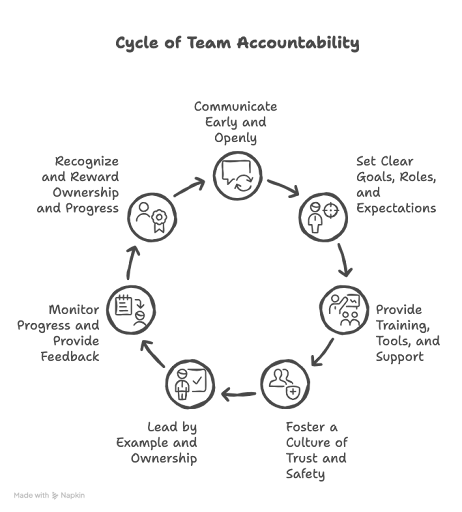
Building accountability in a team doesn’t happen automatically; it requires deliberate effort from leadership. Here are effective ways to introduce accountability and ownership in your team throughout a financial change initiative:
1. Communicate Early and Openly
From my seat as CFO, accountability begins with early, open communication. In any finance transformation, digital financial transformation, or broader business transformation, I do not wait until decisions are finalized to bring the team in. Transparency from day one is essential to execution.
When change is on the horizon, I communicate the what, the why, and the how as early as possible. This approach ensures the organization does not experience transformation as something imposed from above, but as a shared initiative aligned with our corporate strategy and strategic planning process.
Whether we are evaluating a new ERP platform, modern budgeting & forecasting tools, or advanced financial analytics software, I involve the finance organization early. I ask for input on system capabilities, reporting needs, and workflow improvements. This is especially critical for teams responsible for FP&A, financial planning & analysis, and financial dashboard development.
When people participate in shaping the solution, accountability follows naturally. Open, two-way communication builds inclusion, accelerates buy-in, and strengthens ownership. It also reflects the evolving role of the CFO as a performance leader, an evolution often described as the CFO redefining accountability and execution at the enterprise level .
2. Set Clear Goals, Roles, and Expectations
Unclear expectations are the fastest way to destroy accountability. In every finance strategy, transformation strategy, or Business Strategic Planning initiative I lead, clarity is non-negotiable.
Financial change programs introduce new systems, new processes, and new performance targets. That makes precision essential. I define success upfront, quantitatively and operationally using milestones tied to corporate planning, financial management, and cost optimization. Objectives such as reducing close cycles, improving financial statement analysis, or strengthening financial planning discipline are documented and tracked.
Equally important is ownership. Each initiative has clearly assigned responsibility whether for data migration, system training, or change governance. Frameworks like RACI models ensure there is no ambiguity around accountability, especially in cross-functional environments supported by management consulting, corporate finance or business strategy consulting partners.
Clear ownership turns strategy into execution. When everyone understands their role in the strategic business plan, accountability becomes visible, measurable, and enforceable exactly how enterprise change should be managed.
3. Provide Training, Tools, and Support
Accountability without enablement is abdication. As a CFO, I recognize that holding teams accountable requires equipping them with the right capabilities, systems, and support.
Modern finance teams are expected to operate across data management, financial analysis, and advanced FP&A workflows. When we implement new platforms or reporting tools, I ensure structured training, hands-on workshops, and vendor-led enablement are part of the rollout. This is especially critical in initiatives involving digital business, data consulting, or engagement with a data analytics consultant.
Beyond formal training, I prioritize psychological safety. Teams must feel comfortable asking questions, raising risks, and flagging issues early. During major transformations, I often establish change champions or internal support hubs, an approach commonly recommended by finance transformation consulting and business consulting services firms.
When people feel supported, they take ownership confidently. Enablement turns accountability into a sustainable behavior rather than a forced obligation.
4. Introduce a Culture of Trust and Safety
In my experience, accountability cannot exist without trust. A blame-driven culture suppresses ownership, slows execution, and creates hidden risk particularly in finance-led organizations.
I make it clear that raising concerns, admitting mistakes, or challenging assumptions is not only safeit’s expected. In environments shaped by strategic management, business growth strategies, and continuous change, silence is far more dangerous than candor.
Trust is reinforced by how leaders respond when things go wrong. I focus on solutions, learning, and course correction, not finger-pointing. This mindset aligns closely with best practices in executive leadership consulting and leadership consulting, where accountability is framed as a driver of performance.
I also encourage collaboration over competition. High-trust teams execute faster, adapt better, and deliver stronger results. Accountability and trust reinforce each other: when people see leaders and peers owning outcomes consistently, confidence grows, and accountability deepens.
This cultural shift reflects my CFO’s expanding role as a corporate architect shaping governance, execution, and organizational behavior in tandem .
5. Lead by Example and Ownership
From my seat as CFO, accountability always starts with me. In any finance strategy or business transformation initiative, the tone is set at the top. I cannot expect my team to take ownership if I do not model it myself. In a digital financial transformation, leadership credibility is currency, and it is earned through visible ownership.
That means holding myself to the same standards I set for others. If I miss a commitment, I acknowledge it. If a decision needs correction, I say so openly. This approach is foundational to strong executive leadership consulting principles and effective strategic management. Teams pay close attention to how leaders behave under pressure, especially during moments of uncertainty.
When leaders demonstrate accountability, it signals that responsibility is embedded in how we operate. This mindset aligns with the evolving role of the CFO as outlined in Global Finance Executive Redefines the Modern CFO as Chief Performance Officer, where financial leaders are expected to actively own outcomes.
I make it a point to stay deeply engaged. If the organization is adopting new financial analytics software, I attend the same training sessions as my team. If we introduce new budgeting & forecasting processes, I follow them rigorously. This consistency reinforces trust and strengthens execution across corporate planning and FP&A functions.
When something goes wrong, I address it directly. Saying “that is on me” is leadership. In my experience, this approach accelerates problem-solving, reinforces business management discipline, and encourages teams to take responsibility without fear.
6. Monitor Progress and Provide Feedback (Without Micromanaging)
Accountability does not end once expectations are set. In any Finance Transformation Consulting engagement or internal change program, I insist on disciplined progress monitoring paired with autonomy. Visibility is essential; micromanagement is not.
We establish clear milestones tied to financial planning & analysis (FP&A) objectives, supported by transparent metrics and shared financial dashboards. Whether we are tracking close-cycle reductions, adoption of new systems, or improvements in financial statement analysis, the data is visible to everyone involved. This is where strong data management and support from a data analytics consultant become invaluable.
Metrics create ownership. When teams can see progress in real time, accountability becomes collective rather than imposed. This approach reflects best practices commonly seen across management consulting corporate finance and business strategy consulting engagements.
Equally important is continuous feedback. I do not wait until the end of a project to address issues. If someone is blocked, we address it early. If performance exceeds expectations, we acknowledge it immediately. This cadence is critical for retention, engagement, and long-term business growth strategies.
At the same time, I am deliberate about avoiding micromanagement. Accountability thrives when people have decision-making space within clearly defined guardrails. As highlighted in CFO as Corporate Architect: Rewriting the Rules, modern finance leaders succeed by empowering teams while maintaining strategic oversight.
In practice, this means shifting from enforcement to coaching. Regular check-ins replace constant oversight. The result is stronger ownership, faster execution, and a healthier culture of financial responsibility.
7. Recognize and Reward Ownership and Progress
Recognition is a strategic lever. In complex initiatives spanning business consulting services, global business services, or multi-phase digital transformation strategy rollouts, momentum matters.
When individuals or teams demonstrate ownership, I make it visible. Whether it is meeting a critical milestone, resolving a data issue, or driving cost optimization, recognition reinforces the behaviors we want repeated. Public acknowledgment signals that accountability is valued across the organization.
Rewards do not need to be extravagant. A leadership call-out, a written note, or a team acknowledgment can have a measurable impact on morale. In high-performing finance organizations, recognition is tightly linked to sustained execution and long-term business development strategy.
Importantly, I also recognize accountability during setbacks. When someone steps forward to fix an issue rather than deflect responsibility, that behavior deserves attention. Over time, this creates a self-reinforcing culture where ownership becomes the norm.
Conclusion
Financial change programs are inherently complex. Whether driven by digital business expansion, regulatory requirements, or evolving corporate strategy, success depends less on tools and more on accountability. Book a call with me and let’s talk about the transformation.
From my experience leading large-scale transformation strategy initiatives, teams perform best when expectations are clear, support is consistent, and leadership behavior aligns with stated values. Accountability builds trust, and trust accelerates execution.
This approach reflects the modern CFO’s role as a strategic architect of the business, not merely a steward of numbers, a perspective reinforced in Sumedh Deo: The CFO as Corporate Architect Rewriting the Rules of Global Finance. When accountability is embedded, finance teams become more agile, resilient, and capable of driving sustained value.
In a volatile environment, that capability is a competitive advantage.
FAQs: Building Accountability and Change Readiness in Teams
Q1: What is a financial change program?
A financial change program is a structured initiative that significantly alters how an organization manages its financial operations, systems, or decision-making processes. This may include ERP implementations, restructuring finance operations, introducing new financial planning models, or upgrading financial analytics capabilities.
These programs often sit at the intersection of financial consulting, business consultancy firms, and internal finance leadership. They typically support broader objectives such as scalability, compliance, improved insights, or sustainable business strategy execution.
Because they affect daily workflows across accounting, FP&A, and reporting, successful financial change programs require strong leadership, clear accountability, and consistent communication. When executed well, they enable better decisions, stronger governance, and long-term organizational resilience.
Q2: What does “change readiness” mean, and why does it matter?
Change readiness refers to how prepared and willing an organization (and its people) are to successfully implement change. According to change management experts, it’s the level to which your organization is prepared, willing, and able to embrace a change. This concept spans several facets: having the right infrastructure and resources in place (organizational readiness), a culture that is positive about change (open attitudes), and individuals who feel capable and motivated to change (individual readiness).
Change readiness matters because it’s a strong predictor of whether a change initiative will succeed or struggle. If your team is unprepared, for instance, if they lack training, or there’s unresolved fear/resistance, even a well-planned project can falter. Building change readiness means proactively addressing those areas:
providing training for new tools, communicating clearly about the what/why of the change, and securing leadership support and buy-in. Essentially, it’s about cultivating an environment that welcomes change rather than dreading it. When your team is change-ready, they adapt faster, encounter less confusion, and are more likely to deliver the expected benefits of the financial change program.
Q3: Why is accountability so important during organizational changes?
Accountability is important in any context, but during organizational changes it becomes absolutely critical. That’s because change initiatives often involve uncertainty, new tasks, and cross-functional work, which can lead to chaos if people aren’t owning their parts. When accountability is strong, each team member takes responsibility for specific tasks and outcomes, so nothing falls through the cracks. It creates clarity on who will do what, which keeps the project on track.
Also, accountability helps in overcoming resistance to change. In many transformations, one of the biggest roadblocks is employees being hesitant or disengaged. By instilling accountability, you turn team members into active participants; they feel a personal stake in making the change succeed. Moreover, accountability induces open communication and trust (as discussed earlier). This means issues are flagged and resolved rather than hidden.
Without accountability, a change program can suffer from finger-pointing, missed deadlines, and low morale. In fact, a lack of accountability doesn’t just hurt one person’s performance; it can drag down the whole team, leading to disengagement and distrust. In summary, accountability during change is what ensures that plans turn into actions and that the team stays cohesive and focused on the end goal.
Q4: How can leaders encourage accountability without micromanaging?
Encouraging accountability without crossing into micromanagement is a balancing act, but it’s very achievable with the right approach. Firstly, set clear expectations and outcomes (as we covered earlier). When everyone knows what’s expected, you don’t need to hover over their shoulder; you can trust them to deliver results. Next, establish regular check-ins or progress updates that are collaborative in tone. Use these meetings to ask questions and offer support rather than to scold or nitpick.
For example, instead of saying, “I need to approve every tiny step you take,” you might ask in a team review, “Are there any obstacles blocking your progress that we should address?” This shifts you from a police role to a coach or partner role.
Another strategy is to give autonomy within guardrails. Define the boundaries (timeline, budget limits, compliance needs), and then let the team exercise judgment within those limits. Research suggests that empowering team leads to make decisions within clear financial guardrails results in faster decisions and greater confidence, ultimately bringing out a stronger culture of responsibility.
Essentially, you’re saying, “I trust you to handle this, as long as it stays within these agreed parameters. If something big changes, let’s talk.” This approach promotes ownership because employees feel their judgment is valued, yet you still have controls to prevent major issues.
Finally, lead by example in how you handle your own tasks, and be accountable and open to feedback yourself. When your team sees that, they know you’re all on the same page, not just looking over their shoulder. By combining clarity, supportive check-ins, autonomy, and role-modeling, leaders can maintain high accountability while keeping the team’s morale and initiative intact.
Q5: What should I do if someone on the team isn’t being accountable?
Despite a leader’s best efforts, there might be cases where an individual is unable to meet their responsibilities during a change program. The first step is to address it promptly and directly. Have a one-on-one conversation with the team member to understand what’s going on. Sometimes, lack of accountability stems from confusion or overwhelm; perhaps they aren’t clear on what’s expected, or they’re struggling with a part of the change.
In such cases, re-clarifying their role or providing additional support or training can resolve the issue. It’s important to communicate the impact of their lapses in a constructive way (e.g., “When deadlines are missed, it puts extra strain on others and risks the project timeline”).
If the issue is more about attitude, resistance or unwillingness to take ownership you may need to reinforce the importance of accountability. Remind them how their contributions tie into the team’s success and the organization’s goals.
Sometimes painting the bigger picture reignites a sense of responsibility. Also, ensure there are appropriate consequences and follow-ups. This doesn’t mean punishment in a harsh sense, but there should be accountability for accountability, so to speak.
For example, set specific improvement goals and check back in regularly on their progress. A helpful approach is to pair feedback with an opportunity for them to step up. For instance, assign them a meaningful responsibility with trust, making it clear you believe they can do it. This vote of confidence can motivate a change in behavior.
Meanwhile, continue to model accountability yourself and highlight examples of others doing it right. In team settings, positive peer pressure can also encourage someone to align with the culture.
If after support and clear feedback the person still refuses to be accountable, then it may become a performance issue to handle with your HR or management processes. But in many cases, open dialogue, clarity, and support will get an underperforming team member back on track and fully bought into the change initiative.
By focusing on these strategies and maintaining a supportive leadership style, you can turn accountability from a fancy word into a daily practice, ensuring your financial change program achieves its objectives and leaves your team stronger than before.