

Introduction
Accountability might not be the flashiest topic in leadership, but it’s arguably one of the most critical. When a chief executive at a global bank faces shareholders after a misstep, their willingness to own the problem can make or break trust.
Why is accountability important in leadership?
The answer lies in its impact on credibility, culture, and performance, especially in high-stakes industries like finance, where a single leader’s decisions can ripple through economies. Many executive coaching emphasize that a leader who holds themselves accountable sets the tone for the entire organization.
In fact, accountability is how leaders turn good intentions into tangible results. It’s the glue that binds a leader’s words to their actions and earns them the confidence of their teams, investors, and customers.
I, Sumedh Deo, in this blog will explore the significance of accountability in leadership and glean insights from global finance executives who have learned, sometimes the hard way, that accountability can never be optional. From building trust within a team to steering an organization through crises, we’ll see why accountability separates effective leaders from the rest.
We’ll also look at how leaders can introduce a culture of accountability (as often advised in executive advisory circles) and answer common questions on this essential leadership trait.
Accountability: The Cornerstone of Effective Leadership
From my perspective as a CFO, accountability in leadership is fundamentally about being answerable for decisions, outcomes, and trade-offs. It means standing behind your judgment, transparently explaining results, admitting errors early, and fulfilling obligations to shareholders, employees, regulators, and customers. In modern corporate strategy and strategic management, accountability is the operating discipline that separates credible leadership from performative leadership.
Trust and credibility are built through accountability
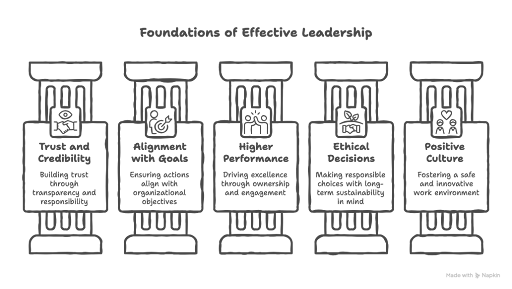
Trust is the true currency of leadership, especially in finance-led organizations. When leaders consistently follow through on commitments and take responsibility when outcomes fall short, they earn credibility that no presentation or narrative can manufacture. In banking and financial services, where leaders are entrusted with capital, liquidity, and long-term value creation, accountability is inseparable from governance.
I have seen firsthand how quickly confidence erodes when accountability weakens. Barclays CEO C.S. Venkata krishnan has repeatedly emphasized that values and integrity underpin trust, and that reputational damage can destroy confidence faster than financial losses. That principle applies far beyond banking. Whether we are managing financial planning, overseeing budgeting & forecasting, or executing a business growth plan, leaders who avoid accountability undermine stakeholder confidence and amplify risk.
Accountability aligns execution with organizational goals
Accountability is one of the most effective alignment mechanisms in any strategic planning process. When leaders set clear expectations, define ownership, and hold themselves to the same standards they expect of their teams, execution sharpens. People understand what success looks like, how performance is measured, and how their role connects to the broader business development strategy and growth strategy.
This alignment is especially critical during periods of business transformation and digital business expansion. Without accountability, even the most elegant strategic planning framework collapses into fragmented execution. With it, individual effort compounds into enterprise momentum.
Accountability drives sustained performance
High-performing teams operate with a strong sense of ownership. When leaders model accountability, teams respond by taking initiative, solving problems proactively, and staying engaged. This dynamic is essential across finance, operations, and business strategy consulting engagements. Performance improves n because they feel responsible for outcomes.
In my experience of which I often write and share on my LinkedIn, organizations that embed accountability into their finance strategy, financial planning & analysis (FP&A), and operating cadence consistently outperform those that rely on control-heavy oversight. Ownership creates speed. Clarity reduces roadblocks. Together, they elevate results.
Accountability enables ethical, sustainable decision-making
True accountability forces leaders to consider long-term consequences. In finance leadership, that means balancing performance with risk, governance, and sustainability in business. Leaders who know they will be answerable for outcomes are less likely to take reckless shortcuts or obscure uncomfortable truths.
This mindset is central to strategic sustainability and sustainable business strategy. Whether evaluating investments, managing enterprise risk, or guiding a digital transformation strategy, accountability acts as a safeguard against decisions that look good in the quarter but damage enterprise value over time.
Accountability shapes culture and engagement
When accountability is modeled at the top, it creates psychological safety across the organization. People are more willing to surface issues, admit mistakes, and focus on solutions rather than blame. Over time, this builds a culture of continuous improvement, innovation, and resilience critical in complex environments shaped by digital financial transformation, data-driven decision-making, and evolving regulatory expectations.
Conversely, when leaders avoid accountability, cynicism takes hold. Engagement drops. Execution slows. The cost of disengagement is real, measurable, and often hidden until performance declines.
In short, accountability is centered around creating an environment of clarity, trust, and disciplined execution. It is how leaders translate vision into repeatable results, particularly in complex, global organizations.
Lessons from Global Finance Leaders on Accountability
Nowhere is the impact of accountability more visible than in global finance. As the role of the CFO has evolved into a performance leader shaping enterprise execution, accountability has become a design principle. This evolution has been widely discussed in the context of the CFO becoming a Chief Performance Officer and corporate architect of execution and governance.
Trust and transparency are non-negotiable
In finance, trust underpins everything. Nasdaq board advisor Byron Loflin has noted that accountability is essential when leadership decisions carry systemic consequences. Whether managing a cyber incident, liquidity risk, or reporting irregularities, accountable leadership marked by transparency and swift corrective action is the fastest way to stabilize confidence.
The lesson from the 2008 financial crisis remains relevant: institutions that survived did so not because they avoided losses, but because leaders understood the risks they were taking and were prepared to answer for them. Those that failed often suffered from accountability breakdowns in risk management, corporate planning, and governance.
As C.S. Venkata krishnan has observed, “You can’t be the CEO in the newspapers every week for the wrong reasons.” Accountability and integrity are inseparable. Leaders who constantly deflect responsibility lose credibility quickly internally and externally.
This leadership philosophy aligns with the modern view of the CFO as a corporate architect, responsible for aligning strategy, governance, and execution across global finance functions.
Learning from Scandals: Accountability as a Recovery Mechanism
High-profile failures offer some of the clearest lessons on accountability. The Wells Fargo cross-selling scandal demonstrated how delayed accountability compounds damage. Leadership initially minimized the issue, allowing unethical practices to persist. When accountability finally surfaced through refunds, leadership exits, and structural changes it was painful but necessary to begin restoring trust.
The lesson is straightforward: failing to act accountably early turns manageable risks into existential threats. The same pattern appeared during the collapse of Lehman Brothers, where poor accountability in financial analysis, risk ownership, and governance accelerated the loss of confidence.
Even in fintech and crypto-driven digital strategy environments, the pattern holds. Innovation cannot compensate for weak accountability. Organizations that prioritize governance, compliance, and ownership are far more likely to earn trust and achieve sustainable growth.
From a CFO’s standpoint, I would urge you to fill in your details and book a call now because accountability is a core performance mechanism that underpins trust, aligns execution, and protects enterprise value in an increasingly complex global economy. Most importantly, it’s high time you take action on it.
FAQs
What is accountability in leadership?
Accountability in leadership means that a leader is responsible and answerable for their decisions, actions, and the outcomes that follow. It involves being transparent about one’s choices and owning up to results, whether they are successes or failures. An accountable leader doesn’t play the blame game or make excuses when things go wrong. Instead, they acknowledge issues, address them, and learn from them. In practice, accountability means keeping your commitments and doing what you said you would do.
For example, if a business leader promises a certain strategic goal, they take ownership of achieving it and report honestly on progress. It’s about building trust; when leaders are accountable, their teams and stakeholders know that the leader will reliably follow through on promises and ethically manage setbacks.
Why is accountability important in leadership?
Accountability is critically important in leadership because it builds the foundation of trust and integrity that effective organizations are built on. When leaders are accountable, they set a powerful example; it encourages everyone else in the organization to take responsibility too. This leads to better alignment with goals, higher performance, and a healthier culture.
Moreover, accountability is important for maintaining credibility with stakeholders: employees trust leaders who own up to mistakes, and investors or customers have more confidence in companies where leadership is transparent and trustworthy.
Conversely, if a leader lacks accountability, it can result in confusion, low morale, ethical lapses, or even financial scandals. In high-stakes fields like finance, we’ve seen that accountability (or the lack of it) can determine a company’s survival. Overall, accountability is the glue that links leadership intention to actual results; without it, even the best plans can fail due to poor execution or lost trust.
How can leaders demonstrate accountability?
Leaders can demonstrate accountability through everyday actions and decisions. A few concrete ways include:
1) Keeping commitments: Do what you say you will do, whether it’s meeting a deadline or upholding a company policy. If circumstances change, communicate why and reset expectations; don’t just let things slip.
2) Owning up to mistakes: When something goes wrong, an accountable leader publicly acknowledges the issue without deflecting blame onto others. For example, saying, “I take responsibility for this error, and here’s how we’ll fix it,” shows accountability.
3) Being transparent: Share information openly with your team and stakeholders. This might involve reporting accurate results (even if they’re disappointing) or explaining the rationale behind tough decisions.
4) Seeking feedback and acting on it: Encouraging your team to give you honest feedback and then making improvements shows that you hold yourself answerable to high standards.
5) Holding others accountable fairly: This means setting clear expectations and following up. If a team member falls short, address it constructively and help them get back on track.
By consistently modeling these behaviors, leaders visibly demonstrate that they take responsibility seriously. Over time, this consistency cements their reputation as an accountable leader.
How do you build a culture of accountability in a team or organization?
Building a culture of accountability starts with leadership and then extends to every level of the organization. Here are steps to create such a culture:
1) Set clear goals and roles: Ensure everyone knows what is expected of them and how their work ties into larger objectives. Clarity makes it easier for individuals to own their part.
2) Lead by example: Leaders and managers should embody accountability (meeting their own obligations, admitting mistakes, etc.), as employees will take cues from their behavior.
3) Encourage open communication: Make it safe for team members to speak up about challenges or mistakes without fear of unfair punishment. Regular check-ins, transparent discussions of results, and an open-door policy can help.
4) Provide feedback and support: Give both positive feedback when someone takes responsibility and constructive feedback when things slip. Equip people with the training and resources to meet their responsibilities. Sometimes lack of accountability is a result of people feeling they aren’t empowered to succeed.
5) Align accountability with growth: Emphasize that accountability is about learning and improvement. Celebrate when the team holds itself accountable and solves a problem. You can even implement team rituals like post-mortems after projects to discuss what went well or poorly in a blame-free way.
Over time, these practices create a norm where everyone from interns to executives feels a sense of ownership for their work and for the organization’s outcomes. In such an environment, accountability becomes a shared value rather than a top-down mandate.
What are the consequences of a lack of accountability in leadership?
When accountability is missing at the leadership level, the consequences can be severe for both the leader and the organization. On a cultural level, lack of accountability from the top often leads to blame-shifting and dysfunction. If employees see leaders never admitting mistakes or constantly passing the buck, they will likely mimic those behaviors.
This can result in low morale, distrust among team members, and poor collaboration. Performance can also suffer, projects may fall behind or fail because no one feels truly responsible to drive them to success or to flag problems early. Over time, talent might leave the organization, frustrated by a chaotic or unfair environment.
On a business level, unaccountable leadership can damage a company’s reputation and financial health. For instance, if a CEO hides issues or provides misleading information to investors or the public, it can lead to scandals, legal troubles, or loss of market confidence.
Many corporate failures and crises (from financial frauds to safety incidents) have been traced back to leaders not being upfront and accountable when issues first arose.
The fallout can include regulatory penalties, stock price declines, and loss of customers. In short, a lack of accountability creates blind spots; small problems fester into big ones because no one takes ownership to fix them.
As the saying goes, “a fish rots from the head down.” If leadership will not be held accountable, it’s very difficult for an organization to thrive. That’s why cultivating accountability at the top is so critical to long-term success and integrity.