Finance is entering a new era, one defined by clarity, intelligence, and enterprise influence.
For the past decade, many of us have focused on transformation as a series of isolated upgrades: a new ERP implementation, a dashboard project, or a talent rotation. But as we look toward the next ten years, the finance organizations that will truly lead are not just collections of improved parts. They are the ones that operate as engines: integrated, predictive, disciplined, and deeply embedded into how the business thinks and acts.
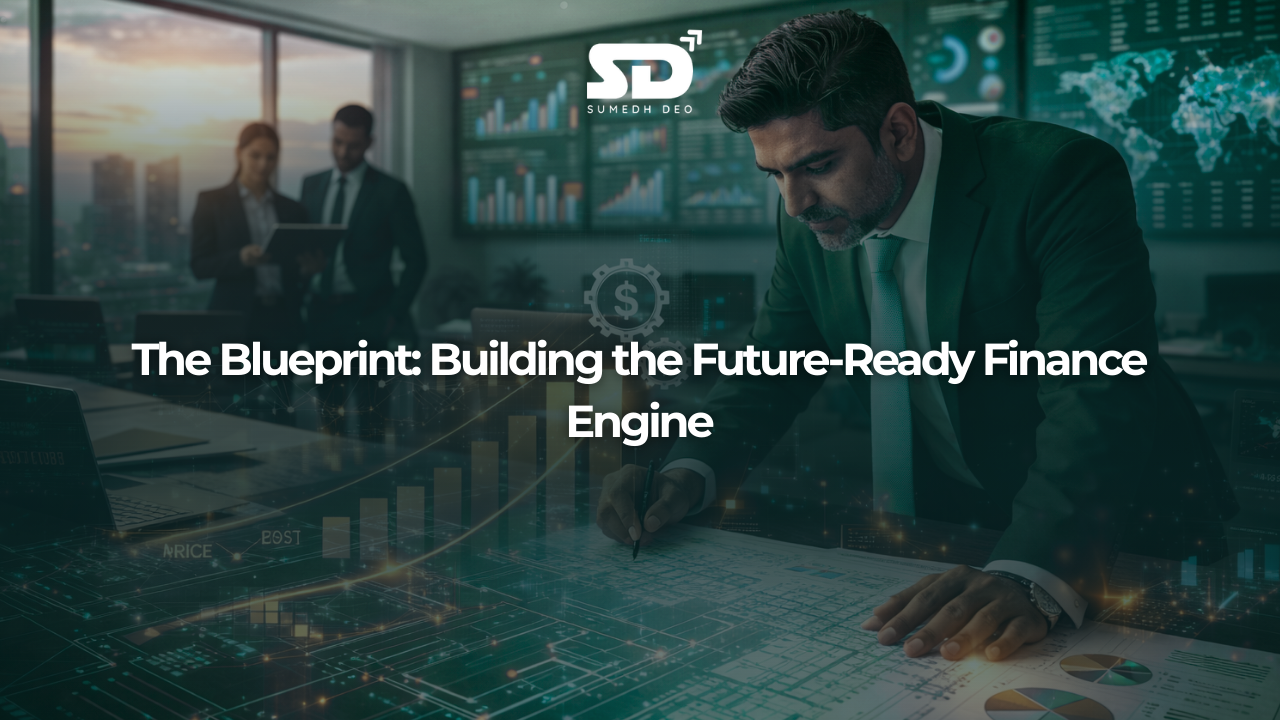
When I talk about a future-ready finance engine, I am not talking about incremental improvements. I am describing a system that brings together data infrastructure, AI capability, talent evolution, pricing maturity, cash discipline, and investor-grade storytelling into one single coherent architecture.
This is a finance transformation by design. It requires us to move beyond the traditional view of finance as a support function and rebuild it as the thinking engine of the organization.
Based on my experience observing high-performing organizations, here is the six-part blueprint for building that engine.
1. The Data Spine: Moving from Reconciliation to Direction
The foundation of any modern finance function is its data management capability. Yet I still see organizations struggle with growth simply because their insights are trapped inside disconnected systems.
The Core Problem
In many legacy operating models, data exists in silos. The ERP doesn’t speak fluently to the EPM, and the BI tools are often layering visuals over messy foundations. The result? Finance teams spend more time reconciling data than interpreting it. When your best people are tied up validating whether the numbers are correct, they have no capacity to tell you what the numbers mean.
The Strategic Shift
Everything starts with the data spine. A future-ready finance engine requires that data flows seamlessly from transaction to insight, from insight to narrative, and from narrative to decision.
This is not just an IT project; data analytics architecture is a leadership choice. As finance leaders, we must mandate a centralized operating model that allows us to:
- Pivot quickly when market conditions change.
- Model future outcomes with confidence rather than guesswork.
- Deliver board-ready intelligence that leaders expect.
When the spine is strong, the whole organization stands taller. The business gains direction because it can finally understand the signals pointing forward.
2. GenAI: The Accelerator of Human Capability
Artificial Intelligence has captured the industry’s imagination, but we need to look past the hype. What matters most to me isn’t the technology itself, but how it changes the way our teams work.
Beyond Automation
We know GenAI can create forecasts, summarize variance drivers, draft narratives, analyze contracts, and surface risk patterns in seconds. These are table stakes. The real value comes when AI creates an exponential impact on decision velocity by connecting machine precision with human judgment. This is the essence of digital financial transformation.
The New Operating Rhythm
I have seen finance teams transform from data gatherers to value interpreters simply because AI removed the manual weight they were carrying. Instead of firefighting, they are now focused on financial planning & analysis and scenario planning.
To make this real, GenAI must be woven into the daily operating rhythm. It creates a new baseline for speed and clarity when used in:
- Pre-read summaries for executive meetings.
- Period-close routines to shorten the cycle.
- Planning cycles and performance dialogues.
The future revolves around elevating finance. When we let the machine handle the processing, we liberate the human to handle the strategy.
3. Reimagining Talent: The Shift to Risk Intelligence
The AI era compels us to remake the very shape of our roles. We have to ask a difficult but necessary question: If automation takes over reconciliations, report preparation, and transactional effort, what work is left for people to do?
The Capability Shift
The answer lies in higher-order thinking. Future-ready finance teams must focus on interpretation, strategic planning, business partnering, and outcome ownership.
This requires a fundamental redesign of our traditional pillars:
- FP&A must move closer to strategy.
- Controllership must evolve from “scorekeeper” to “risk intelligence.”
- Operations Finance must become architects of systems and processes.
A Culture of Inquiry
Talent redesign is a capability shift, where upskilling happens continuously. We need to build teams that learn to ask better questions. As we implement productivity systems to drive focus and minimize clamor, the culture naturally shifts from being activity-driven (busy work) to insight-driven (value work). This is the hallmark of effective executive development.
4. Pricing Discipline: The Strategic Lever
The future of finance also lies in how confidently the organization protects its value. Pricing is among the most strategic levers a services business has, yet it is often the most emotionally influenced.
Removing the Emotion
In many organizations, pricing is informed by the fear of losing a deal rather than data. A future-ready finance engine changes this by embedding pricing discipline directly into the corporate strategy.
When pricing discipline matures, margin stops depending on the skill of an individual negotiator. Instead, it becomes a systemic advantage.
The Governance Model
To achieve this, we must ensure that:
- Deal governance becomes consistent across the board.
- Commercial narratives are strengthened with data.
- Minimum viable margin thresholds become part of the culture.
- Win–loss intelligence flows back into business development strategy, so we learn from every deal.
5. A Cash Culture That Extends Beyond Finance
We often treat working capital as a finance metric, but in reality, working capital is a reflection of how the entire organization behaves.
Breaking the Silos
The future-ready finance engine builds a cash culture that reaches sales, procurement, operations, and delivery. Effective budgeting & forecasting means making it clear that:
- Sales routines influence DSO (Days Sales Outstanding) months before an invoice is ever raised.
- Procurement strategies strengthen DPO (Days Payable Outstanding) through intelligent terms.
- Inventory and fulfillment behaviors determine DIO (Days Inventory Outstanding) long before finance measures it.
Resilience as an Outcome
When teams across the business see how their daily work shapes cash, they operate with more maturity, discipline, and trust in the system. A cash culture emerges from leadership behavior and organizational rhythm. When cash becomes a conversation across the enterprise, resilience becomes a natural outcome.
6. Investor-Grade Communication as a Daily Standard
Finally, the finance teams of the future will distinguish themselves by how they articulate value.
The New Language
Investor-grade communication is no longer a skill reserved for earnings calls or quarterly board presentations. It is fast becoming the daily language of modern financial analysis.
Communication must stop being a reporting activity and start being a strategic differentiator.
- Narratives need to be sharp, structured, and anchored in coherent insight.
- Explanations of variance should be forward-looking, not just historical explanations.
- Strategic implications need to be so clear that leaders can take action without hesitation.
The Impact on Leadership
I have learned that when finance communicates with this level of clarity, it changes how the organization sees itself. It elevates the confidence of leadership teams, aligns stakeholders faster, and unlocks higher-quality decisions.
Conclusion: Integrating It All into One Engine
The real transformation happens when all these elements like data, AI, talent, pricing, cash, and communication; function as one engine.
When data flows into insight, insight flows into decisions, decisions flow into action, and action flows back into measurable outcomes, the system becomes self-reinforcing. A future-ready Finance Transformation Consulting engine is unified. It runs on clarity, it is predictable in discipline, and at the same time, it is agile in execution.
It expands because its architecture is intentional.
This is the finance organization that redefines business direction. It is the organization that leaders depend on because it has perspective. It is the organization that can lead through volatility with confidence because it was designed to function with intelligence, speed, and purpose.
This engine is something we build brick by brick, system by system, and behavior by behavior. And when built correctly, it becomes the most powerful force for sustaining enterprise growth.