

Accountability can be a double-edged sword in team management. On one hand, a lack of accountability leads to missed goals and finger-pointing; on the other, a heavy-handed approach may feel like micromanagement and potentially slow the team down. How do successful leaders strike the right balance?
The key is to build a performance culture where team members willingly take ownership of their roles and results. In such a culture, I recognize accountability as a powerful engine that drives better performance and financial outcomes. In this blog, I, Sumedh Deo will help you explore why accountability is crucial for high-performing teams, dispel the myths that it drags down results, and outline practical steps to increase accountability in your team without sacrificing speed or financial performance.
Why Accountability Is Essential for a High-Performance Culture
Just like a Formula One pit crew, where each person is accountable for a specific task, a team with clear ownership can execute quickly and flawlessly. In business, accountability plays a similar role; it ensures everyone knows their responsibility and delivers, which boosts overall performance.
Research backs this up: companies with strong accountability cultures are 2.5 times more likely to deliver above-average financial results. In other words, accountability operates as a catalyst that propels organizations forward.
A true performance culture is essentially a culture of accountability. It’s one in which individuals deliver on their promises, and they don’t commit to tasks unless they can achieve them to the expected standard and timeframe. When team members consistently follow through, trust grows and projects stay on track.
In contrast, the absence of accountability is a silent killer of performance problems, fester, deadlines slip, and outcomes suffer. In fact, organizations without clear accountability are three times more likely to experience project failures. The message is clear: accountability is the backbone of high-performing, results-driven teams.
It’s important to note that real accountability is about ownership and clarity. High-performing teams often demonstrate something powerful: peer accountability. A Harvard study found that on the best teams, colleagues respectfully call out problems and hold one another accountable immediately, which boosts innovation, trust, and productivity.
By addressing issues among themselves, team members prevent small problems from becoming big ones and keep the work flowing smoothly. This kind of accountable environment energizes a team far from slowing things down, it frees managers from constantly “policing” the team and allows everyone to focus on achieving goals.
Avoiding the Accountability Trap: Ownership vs. Blame
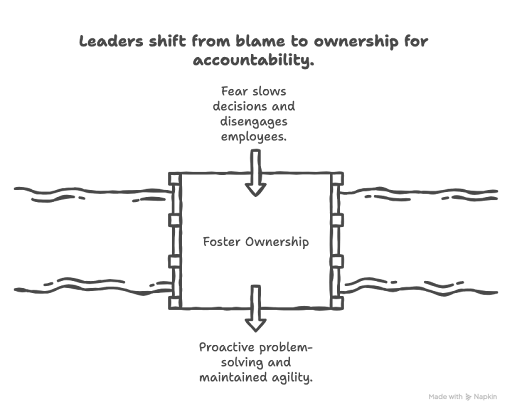
From my perspective as a CFO, I often see leaders hesitate to push for accountability because they fear it will create a culture of anxiety or slow decision-making. That concern usually stems from a fundamental misunderstanding confusing accountability with punitive oversight. When accountability is handled poorly, such as a manager attempting to “hold people accountable” through threats or reprimands, it predictably backfires. Employees do what is necessary to avoid punishment, disengage from outcomes, and stop thinking proactively. In that environment, performance inevitably declines, and execution risk increases.
The reality is that accountability does not need to be and should never be a blame exercise. In high-performing organizations, accountability is built on ownership and empowerment. This principle applies whether we are managing core finance operations, overseeing financial planning, or driving large-scale business transformation initiatives.
In my experience, teams perform best when they are encouraged to take responsibility for outcomes and are supported when things go wrong. When people feel trusted to manage their responsibilities, they hold themselves accountable. Issues surface earlier, problems are addressed proactively, and nothing gets buried to avoid blame. That level of ownership is essential in modern business management and increasingly critical in complex digital business environments.
The key mindset shift for leadership is moving away from the idea of “holding people accountable” in the traditional, enforcement-driven sense, and instead focusing on creating the conditions where accountability happens naturally. That means setting clear expectations, ensuring the right resources are in place, and then giving teams the autonomy to deliver. Accountability, at its core, is about clarity and ownership. Over-control erodes agility. Clarity strengthens it.
This leadership philosophy aligns closely with how the role of finance leadership has evolved. As the CFO increasingly operates as a performance leader across corporate strategy and execution, accountability becomes a design principle, an evolution often described by the CFO evolving into a Chief Performance Officer shaping enterprise performance.
How I Build Accountability Without Slowing Performance
When introducing accountability while preserving speed and momentum, I focus on a balanced, execution-driven framework. These six practices consistently deliver results across finance, operations, and broader business strategy consulting engagements.
Set crystal-clear expectations and ownership
Accountability collapses in the presence of ambiguity. Every leader must understand what they own and how their outcomes connect to broader goals. Whether we are executing a strategic planning process, managing budgeting & forecasting, or advancing a business growth plan, clarity of ownership is non-negotiable. Simple accountability charts that map tasks or KPIs to owners reduce hassle, prevent gaps, and eliminate the need for constant oversight.
Lead accountability from the top
Accountability always starts with leadership. I hold myself accountable publicly, owning missed targets, explaining root causes, and outlining corrective actions. When leaders demonstrate accountability openly, it sends a powerful signal that performance management is about improvement. This approach is foundational to effective executive coaching with leadership consulting and reflects my modern view of the CFO as a corporate architect rewriting the rules of execution and governance.
Create a culture of open communication and trust
Accountability thrives in trust-based environments. I encourage teams to surface issues early, without fear of blame. Regular check-ins and transparent discussions allow problems to be addressed before they escalate. This blameless, solution-oriented approach accelerates course correction and strengthens engagement. Over time, it creates the shared belief that performance is a collective responsibility essential for scalable business growth strategies.
Use data and feedback as accountability anchors
Clear metrics eliminate subjectivity. I rely on defined KPIs aligned to financial and operational objectives, supported by visible financial dashboards, disciplined financial analysis, and robust financial analytics software. This is where financial planning & analysis, FP&A, and strong data management practices turn performance measurement into real-time decision support. When teams can see results clearly, accountability becomes self-enforcing.
Empower decision-making and avoid micromanagement
Accountability weakens when authority is centralized. I deliberately push decision rights closer to execution whether working with internal leaders, finance management consultants, or external business consulting services. Empowerment signals trust and increases ownership. Clear boundaries matter, but micromanagement destroys momentum. Accountability is about clarity.
Recognize and reinforce accountable behavior
Finally, accountability must be rewarded. When teams meet commitments, take initiative, or solve problems proactively, I make recognition visible. Whether through formal incentives or public acknowledgment, rewarding accountability reinforces it as a core expectation. Over time, accountability becomes peer-driven, reducing reliance on top-down enforcement and supporting long-term cost optimization, resilience, and sustainability in business.
When these practices are embedded into daily operations, accountability becomes part of the operating rhythm. Execution speeds up. Decisions improve. Risks surface earlier. This is precisely what organizations expect from finance leaders today as stewards of performance, governance, and value creation. The CFO’s role as a corporate architect of execution and performance in global finance is no longer aspirational, it is operational reality.
When accountability is designed correctly, it does not slow teams down. It sharpens focus, strengthens ownership, and drives results without constant intervention. From a CFO’s standpoint, that is accountability done right.
Building a Performance Culture Through Accountability
From my vantage point as a CFO, increasing accountability is about deliberately shaping culture. When accountability becomes second nature, the way a team operates fundamentally changes. Blame, denial, and confusion fade into the background, replaced by a shared focus on results, solutions, and collaboration. This cultural shift is one of the most powerful enablers of sustainable performance I have seen across organizations.
When accountability is embedded, people spend far less time avoiding difficult conversations or protecting themselves politically. Instead, they focus their energy on execution and outcomes that matter. In practical terms, this drives measurable gains in efficiency and financial performance. Teams align more effectively around organizational priorities, anticipate risks earlier, and resolve issues before they escalate core objectives of disciplined business management and effective strategic management.
The financial impact of this kind of culture is tangible. When individuals take ownership of costs, revenue, and quality within their remit, overall performance improves. Strong accountability reinforces disciplined finance strategy, tighter cost optimization, and better decision-making across the enterprise. External research consistently supports this connection, showing that organizations with mature accountability mechanisms outperform peers on profitability and execution reliability.
This outcome is obvious. When employees treat business metrics as their personal responsibility, they naturally control waste, capitalize on opportunities, and improve results. Accountability becomes a built-in quality control mechanism, supporting continuous improvement at every level. From a CFO’s perspective, this is where accountability directly reinforces financial planning & analysis, FP&A, and ongoing financial performance analysis.
Importantly, a high-accountability culture sustains itself. New hires absorb expectations quickly when they see ownership modeled consistently across the organization. Leaders no longer need to rely on constant intervention or pressure because teams hold themselves to high standards. This self-regulation frees leadership capacity for higher-value work such as corporate strategy, business Strategic Planning, and long-term business growth strategies.
As a leader, this allows me to focus on direction, enablement, and support rather than supervising execution. The organization moves faster and more cohesively because trust is high and commitments are honored. When setbacks occur, teams respond with problem-solving instead of panic. That resilience is essential for long-term value creation, particularly in complex, fast-moving digital business environments.
In summary, increasing accountability means cultivating clarity, ownership, and trust. When done correctly, accountability becomes a force multiplier aligning day-to-day execution with the broader strategic planning process and accelerating performance rather than slowing it down.
Far from hindering financial outcomes, the right accountability practices improve productivity, innovation, and profitability. The message for any executive is clear: when accountability is a cultural cornerstone, teams deliver consistently and the organization thrives.
Conclusion
From a CFO’s standpoint, accountability and high performance are inseparable. When expectations are clear, communication is open, and leadership support is consistent, accountability strengthens execution without compromising speed or morale. In fact, it enhances performance, work moves faster, quality improves, and engagement rises because people own their results.
This shift requires intentional leadership. It means prioritizing ownership over blame, autonomy over control, and learning over fear. When accountability is framed this way, it becomes a positive habit that fuels continuous improvement and reinforces strong corporate planning and business development strategy.
A practical next step is to assess your current culture and identify one or two changes that would reinforce accountability. I would suggest you connect with me on this soon and discuss elaborately. That may involve clarifying goals within your next initiative, strengthening ownership within your business growth plan, or deliberately delegating decisions you would normally retain. Small, consistent changes compound over time.
The result is a performance-driven organization that exceeds expectations and delivers strong financial outcomes without heavy-handed oversight. From my experience in finance leadership, that is the true power of accountability in action.
FAQs
How do I increase my team’s accountability without micromanaging?
From my experience, accountability improves when goals are clear and ownership is explicit, not when oversight increases. Define the outcomes that matter and explain why they are important, then give teams the autonomy to determine how they deliver. Provide resources and support, use metrics or dashboards to stay informed, and avoid constant intervention. This approach reinforces trust and encourages ownership of critical elements of effective business strategy consulting and leadership.
Accountability is built on clarity and support. When people are trusted to execute within agreed boundaries, they become more engaged and more responsible for results. Leaders can remain informed without slowing progress or undermining confidence.
What is a performance culture, and how does accountability support it?
A performance culture is one where delivering results and improving continuously are shared expectations across all levels. People commit realistically, follow through consistently, and take ownership of outcomes. Accountability is the foundation of this culture. When responsibilities are clear and outcomes are owned, execution becomes reliable and efficient.
Accountability eliminates common performance barriers, such as unclear priorities, blame-shifting, or disengagement and replaces them with coordination, urgency, and shared purpose. Over time, this mindset makes high performance the norm rather than the exception.
Can accountability improve financial performance?
Yes consistently. When individuals take ownership of budgets, targets, and key metrics, decision quality improves. Strong accountability supports better financial planning, tighter spending discipline, and faster corrective action. Organizations that embed financial accountability tend to outperform peers on profitability because waste is reduced, opportunities are captured faster, and problems are addressed early.
High accountability also correlates with greater productivity and innovation, reinforcing financial performance over time. When people treat the organization’s goals and resources as their own responsibility, results follow.
What are some examples of accountability in the workplace?
Examples of workplace accountability include both individual and team behaviors. On an individual level, it could be something like a team member owning a mistake openly and fixing it rather than covering it up.
For instance, if a deadline is missed, an accountable employee will acknowledge it, explain what happened, and propose a solution or new deadline. On a team level, accountability might look like team members regularly updating each other on project status and flagging risks early so nothing is overlooked.
Another example is when peers hold each other to high standards; for example, if someone is consistently late with deliverables, a colleague might have a respectful conversation to address it, rather than leaving it all to the manager. Using tools can also reinforce accountability: project management boards or dashboards where each task has an owner’s name and status visible to everyone encourage individuals to follow through.
In meetings, an accountable team will review commitments from the last meeting and check that each was completed. All these practices create transparency and a sense that “we’re each responsible to the group,” which is the essence of accountability.
How can leaders create a culture of accountability in their team?
Leaders set the tone for an accountable culture. To create one, start by clearly articulating the team’s goals and each person’s role in achieving them. Make sure your team understands not just what they need to do, but why it’s important this gives their work context and meaning.
Next, establish regular routines that reinforce accountability, such as weekly goal check-ins or post-project debriefs to discuss what went well and what can be improved.
It’s also crucial to respond to failures or problems in a constructive way. Instead of reacting with anger or blame when something goes wrong, treat it as a learning opportunity and ask the team member to help figure out how to prevent it in the future.
This approach builds trust and signals that taking responsibility is safe and expected. Additionally, lead by example: hold yourself accountable publicly. If you miss a deadline or make an error, own up to it in front of the team and outline your corrective action. This vulnerability from a leader greatly encourages employees to do the same.
Over time, consistently applying these actions clear expectations, routine check-ins, constructive responses, and role modeling will cultivate a strong culture of accountability. Your team will internalize these norms and start holding themselves (and each other) accountable as part of “how we work here,” driving higher performance with less direct oversight needed.