
Introduction
The role of the CFO has fundamentally changed. Closing the books accurately and on time is now table stakes. Today’s finance leaders are expected to deliver forward-looking insight, quantify risk, and guide strategic decisions often in real time and under uncertainty.
The challenge is scale. Global businesses generate enormous volumes of financial and operational data across regions, systems, and functions. The question is no longer whether data exists, but whether finance can convert it into clear, decision-ready intelligence for the executive team.
This is where digital finance enablement becomes decisive. By leveraging artificial intelligence, advanced analytics, and executive-level dashboards, finance organizations are elevating insight delivery from historical reporting to real-time strategic guidance.
It is telling that a large majority of CFOs now rank digitalization of the finance function as a top priority. I, Sumedh Deo, believe that the mandate is clear: finance must move faster, think forward, and operate as a strategic nerve center for the enterprise.
Understanding Digital Finance Enablement
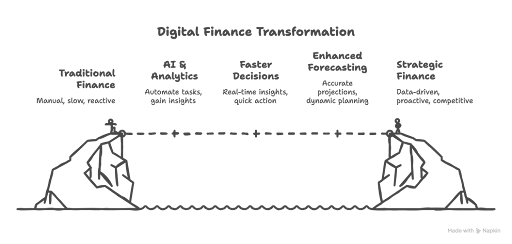
Digital finance enablement should be seen as an operating model shift. At its core, it involves using automation, analytics, and intelligent systems to move finance away from manual, transaction-heavy work and toward insight generation and business partnering.
In practical terms, this means automating routine activities such as transaction processing, reconciliations, and standard reporting, while deploying analytics to surface trends, risks, and opportunities. The objective is to redeploy finance talent toward higher-value work: analysis, scenario modeling, capital allocation support, and strategic advisory.
This shift sits at the heart of most finance transformation programs. CFOs increasingly recognize that a modern finance operating model depends on digital tools doing the heavy lifting collecting, validating, and structuring data so professionals can focus on judgment and decision support. Whether in manufacturing, financial services, healthcare, or retail, the direction of travel is the same.
Organizations investing in cloud-based finance platforms, intelligent automation, and analytics consistently see faster decision cycles and stronger executive alignment. Digital finance enablement creates a finance function that is proactive rather than reactive, and capable of acting as a true strategic partner to the business instead of a back-office reporting center.
AI in Finance: From Automation to Insight
Artificial intelligence is one of the most powerful accelerators of digital finance enablement. Its impact extends well beyond efficiency gains. While AI undeniably reduces manual effort by automating repetitive tasks, its real value lies in insight generation.
AI in finance is increasingly used to improve forecasting accuracy, strengthen risk management, and identify patterns that traditional analysis often misses. Machine learning models can process vast datasets across finance, sales, operations, and supply chain at speeds no human team can replicate. They detect anomalies, uncover correlations, and surface early warning signals before issues become visible in standard reports.
From a CFO’s perspective, this capability fundamentally changes decision-making velocity. Consider how long root-cause analysis used to take when performance deviated from plan days or weeks of meetings, reconciliations, and competing narratives. AI-driven analytics can now diagnose drivers in near real time, isolating whether an issue stems from demand shifts, pricing pressure, operational bottlenecks, or execution failures.
Importantly, AI expands on finance judgment. By automating data preparation and initial analysis, AI frees finance professionals to focus on interpretation, scenario planning, and strategic storytelling. The finance team evolves into an internal advisory function translating AI-generated insight into context-aware recommendations for leadership.
This evolution does require strong governance. CFOs must ensure transparency in models, data integrity, regulatory compliance, and appropriate oversight of algorithmic decision support. When governed well, AI elevates finance from a historical scorekeeper to a forward-looking intelligence engine anticipating risk and opportunity rather than reacting after the fact.
Analytics Dashboards for Executive-Level Insight
Even the most advanced analytics are ineffective if leaders cannot access or interpret them easily. This is why executive-level analytics dashboards have become central to digital finance enablement.
Traditional dashboards were static and backward-looking. They showed what happened, often weeks after the fact. Modern finance dashboards are fundamentally different. Infused with AI and advanced analytics, they operate as dynamic decision-support tools.
A well-designed executive dashboard consolidates real-time financial and operational data, revenue, margin, cash flow, working capital, and key performance indicators into a single, trusted view. More importantly, it provides interpretation. AI-enabled dashboards identify trends, flag anomalies, and surface risks automatically.
For example, if cash collections slow or costs spike unexpectedly, the dashboard highlights the issue, suggests likely drivers, and prompts management attention. Some platforms go further, using machine learning to recommend corrective actions or scenario impacts.
Another critical shift is accessibility. Advances such as natural-language querying allow executives to interact with data directly. A CFO or CEO can ask, “What happens to our cash position if demand softens next quarter?” and receive an immediate, data-backed response. This dramatically reduces reliance on ad hoc analysis cycles and accelerates executive decision-making.
When analytics dashboards are implemented effectively, they transform finance’s role in leadership discussions. Conversations move from debating numbers to debating choices. That shift enabled by digital finance tools is what turns data into strategic advantage.
Dashboards can also integrate data from across the enterprise finance, sales, operations, and customer service to give leadership a holistic view. In fact, AI-powered executive dashboards are often unifying financial, operational, and performance data across departments for cross-functional insight. This broad integration means a CEO or CFO can see, on one screen, how a change in market conditions is impacting everything from the sales pipeline to supply chain costs to the bottom line.
For finance leaders, such capabilities directly translate into better control and foresight. A dashboard augmented by AI might, for example, provide predictive forecasting, real-time risk monitoring, and automated “what-if” analysis all in one place.
Finance teams using these intelligent dashboards can proactively manage risks (say, flagging a potential cash flow shortfall months in advance) rather than reacting after the fact. Executives no longer need to wait for end-of-month reports; insights are surfaced instantly, reducing the need to sift through spreadsheets or wait weeks for answers. One case study of an interactive executive dashboard showed tangible results: decision-making became 30% faster, operational efficiency improved by 40%, and errors were greatly reduced after adopting real-time, AI-driven visualization tools.
The bottom line is that analytics dashboards, especially when combined with AI, give the C-suite a clear line of sight into the organization’s financial health and trajectory. They translate complex data into an easily digestible, visually intuitive form often with traffic lights, charts, and narratives so that executives can grasp issues at a glance and make informed choices quickly.
Opportunities and Benefits of Digital Finance Enablement
Unlocking Value Through Digital Finance Enablement
Having led finance organizations through multiple cycles of transformation, I can say this with confidence: digital finance enablement is about decision advantage. When AI in finance, advanced analytics, and executive dashboards are implemented with intent, they materially change how leaders see the business and how quickly they can act.
Below are the most meaningful benefits I have seen organizations realize when digital finance enablement is done well.
Faster, More Informed Decision-Making
Speed is the first, and often most underestimated, return on investment. In traditional finance operating models, insight arrives too late to influence outcomes. By the time data is consolidated, reviewed, and explained, the moment has passed.
AI-driven analytics and real-time finance dashboards compress that cycle dramatically. Patterns, exceptions, and performance signals surface immediately, allowing leadership teams to act while options are still available. In one organization I worked with, executive decision-making accelerated by nearly 30% after deploying AI-powered dashboards across core financial and operational metrics.
This is about reducing decision latency, which directly impacts profitability, risk exposure, and capital allocation in volatile environments.
Enhanced Forecasting and Planning Accuracy
Forecasting has always been a credibility test for finance leaders. When forecasts are consistently wrong, confidence erodes across the executive team. AI and advanced analytics materially improve this equation.
Modern financial forecasting models combine historical performance with external variables such as market signals, cost inflation, and demand shifts. This allows CFOs to move away from static, spreadsheet-driven planning toward continuous, scenario-based forecasting.
It is no coincidence that 58% of finance teams using AI in finance prioritize forecasting and planning use cases. The ability to run scenarios quickly, whether revenue softness, margin compression, or supply-chain disruption enables proactive planning rather than reactive cost-cutting. Better forecasts translate directly into better capital discipline and more resilient strategic decisions.
Greater Efficiency and Sustainable Cost Control
Efficiency gains are often the entry point for finance transformation, and rightly so. Automating core finance processes/invoice processing, reconciliations, consolidation, and CFO reporting reduces error rates and shortens close cycles.
What matters more, however, is where the saved capacity goes. In digitally enabled finance teams, time previously spent on manual work is redirected toward analysis, business partnering, and executive support. I have seen organizations achieve up to 40% improvements in operational efficiency by fundamentally changing how work gets done.
This is where digital finance enablement directly supports cost control without undermining strategic capability balance every global CFO must manage carefully.
Stronger Risk Management and Governance
Risk builds quietly across transactions, processes, and behaviors. Advanced analytics and AI-driven monitoring allow finance leaders to surface risks earlier and with greater precision.
AI tools continuously scan transactions and performance data to detect anomalies that may indicate fraud, control breakdowns, or emerging financial risk. In complex, multi-entity organizations, this level of oversight is no longer optional; it is essential for governance and compliance.
More importantly, AI-enhanced risk models reduce reliance on manual reviews and hindsight analysis. They enable forward-looking risk management, supporting faster escalation and more informed executive judgment. This strengthens the CFO’s role as a steward of enterprise risk.
Elevating Finance as a Strategic Business Partner
When transactional work is automated and insight is readily accessible, the finance function changes shape. It moves from reporting outcomes to shaping decisions.
Digital finance enablement provides executives with a single, credible view of performance past, present, and projected. This eliminates debate over numbers and redirects conversations toward action. Armed with predictive insights, finance leaders can credibly advise on growth investments, market expansion, pricing strategy, and margin improvement.
In high-performing organizations, finance becomes the analytical backbone of the C-suite, informing decisions across operations, marketing, and strategy. This is where the modern CFO adds the most value by orchestrating insight.
Competitive Advantage in a Data-Driven Market
The competitive implications are clear. Organizations that embed AI, analytics, and executive dashboards into their finance operating model respond faster, allocate capital more effectively, and adapt more quickly to market shifts.
With 35% of companies already using AI and another 42% actively exploring it, digital finance enablement is rapidly becoming table stakes. The advantage now lies in execution quality. Those who move decisively and govern these tools well outperform peers who hesitate or treat AI as an experiment rather than a strategic capability.
Beyond efficiency, these tools also open doors to new business models, predictive services, data-led pricing strategies, and deeper customer insight. Finance plays a central role in unlocking that value.
Leading the Transition Responsibly
None of this happens without discipline. High-quality data, system integration, data literacy, and change management are non-negotiable. AI models require governance. Dashboards require trust. Teams need reassurance that automation elevates their role rather than diminishes it.
This is where CFO leadership matters most. Finance leaders must set standards, validate insights, and visibly champion early wins. When teams see measurable improvements, faster decisions, stronger forecasts, better outcomes/resistance fades quickly.
Finance Leadership in the Digital Age
The conclusion is unavoidable. AI, analytics, and digital finance enablement are no longer optional capabilities. They define whether finance remains a reporting function or evolves into a strategic engine for enterprise value.
The modern CFO is no longer focused solely on what happened. We are responsible for explaining what is happening now and anticipating what comes next. Digital tools give us that capability if we use them deliberately.
For finance leaders beginning this journey, start with the bottlenecks that matter most: slow consolidation, weak forecasting, or limited executive visibility. Pilot targeted solutions, prove value, and scale with intent. Digital finance enablement is an operating mindset.
Those who embrace it lead with confidence. Those who delay risk irrelevance. On this note, book a call with me and let me help you with executive coaching.
In the digital age, finance’s role is expanding from scorekeeper to strategic partner. By using AI, analytics, and dashboards wisely, finance leaders can ensure the numbers are actively driving the business forward with insight.
The companies that succeed in this transformation will enjoy stronger performance and resilience at the enterprise level. In a world awash with data, the ability to extract meaning and foresight from that data is what will set apart the winners, and finance will be at the center of that evolution.
FAQs
What is digital finance enablement?
From a CFO’s perspective, digital finance enablement revolves around redesigning how the finance function creates value for the business.
At its core, digital finance enablement involves using AI in finance, automation, and advanced analytics to move finance away from manual, transaction-heavy work and toward insight-led decision support. Routine activities such as reconciliations, reporting, and data consolidation are automated, while analytics platforms deliver real-time visibility into performance, risks, and trends.
When implemented correctly, this approach transforms finance from a historical reporting function into a forward-looking strategic partner. Executives gain faster reporting cycles, more reliable forecasting, and clearer insight into where the business is heading, not just where it has been.
How is AI used in modern finance departments?
In practice, AI in finance is deployed where scale, speed, and pattern recognition matter most. Common applications include process automation (such as invoice processing and account reconciliation), forecasting and planning, and risk monitoring.
Machine learning models analyze large volumes of financial and operational data to improve forecast accuracy, identify anomalies, and surface trends that would be difficult to detect manually. For example, AI-driven analytics can flag unusual transactions, highlight emerging margin pressure, or predict cash flow outcomes based on current demand signals.
Importantly, AI elevates finance professionals. By removing repetitive manual work, AI allows finance teams to focus on interpretation, scenario analysis, and executive advisory work. For CFOs, this means decisions are made faster and with greater confidence, supported by data rather than intuition alone.
How do analytics dashboards support finance executives?
Well-designed finance dashboards are one of the most powerful enablers of executive decision-making. They translate complex financial data into a clear, real-time view of business performance.
A modern executive dashboard typically consolidates key metrics/cash flow, revenue performance, cost trends, and budget variance into a single, trusted source of truth. But the real value emerges when dashboards are integrated with advanced analytics and AI.
Rather than simply reporting historical results, intelligent dashboards highlight anomalies, forecast outcomes, and prompt action. For example, a dashboard might detect a cost overrun in a specific function and immediately alert leadership, explaining the likely drivers and potential impact on margins.
For finance executives, dashboards reduce reliance on static reports and endless spreadsheets. They enable faster conversations, clearer communication with stakeholders, and more confident decision-making based on current, reliable data.
What are the business benefits of digital finance enablement?
The benefits of digital finance enablement extend well beyond efficiency gains. First and foremost, it accelerates decision-making by delivering timely, data-driven insights to leadership teams. This agility becomes a competitive advantage in uncertain markets.
Second, organizations experience more accurate forecasting and planning as AI and advanced analytics incorporate both historical performance and external variables. This leads to better capital allocation and more resilient strategic plans.
Third, automation improves operational efficiency by reducing errors, shortening close cycles, and lowering the cost of finance operations. At the same time, risk management improves as analytics continuously monitor transactions and performance for potential issues.
Perhaps most importantly, digital finance enablement elevates the role of finance itself. Finance teams move from reporting results to shaping strategy advising on profitability, growth opportunities, and trade-offs with evidence-based insight. In my experience of which I also write about on my LinkedIn, this shift fundamentally changes how the CFO contributes at the executive table.
Is digital finance enablement relevant across industries?
Yes and this is one of the most misunderstood aspects of finance transformation. While use cases differ by sector, the underlying principles of digital finance enablement apply universally.
A bank may focus on AI-driven fraud detection and credit analytics, while a manufacturing company may prioritize supply chain visibility and working capital optimization. A healthcare organization might emphasize compliance and cost transparency. But in each case, the objective is the same: better insight, faster decisions, and stronger governance.
Finance is a universal function. Whether in technology, consumer goods, healthcare, or the public sector, leaders benefit from real-time reporting, predictive analytics, and executive dashboards. As cloud-based platforms become more accessible, even smaller organizations are adopting these capabilities.
Across industries, the trend is clear. AI-driven finance and real-time analytics are becoming standard expectations. The real distinction lies in how thoughtfully these tools are implemented and governed.