
Let me paint a picture I have seen more times than I care to count. A company invests millions into a cutting-edge financial system as part of a broader business transformation. The finance strategy is well thought through, the technology is proven, the implementation partner is reputable. And yet, eighteen months later, the promised value has not materialized.
When that happens, the issue is rarely the system or the transformation strategy itself. More often, it is people.
Across large-scale transformations, whether driven by digital financial transformation, cost optimization, or global business services nearly 70% fail to deliver their intended outcomes. The common denominator far ahead from flawed strategic planning or weak financial planning & analysis (FP&A). It is resistance, misalignment, and a leadership team that underestimated what it truly takes to change how an organization thinks and behaves.
As far as I, Sumedh Deo and from my seat as a CFO, this is where many finance-led initiatives quietly lose ROI. The organization struggles to live the change.
This is precisely why change readiness and culture programs deserve far more attention than they typically receive. They are value enablers. Without them, even the most sophisticated financial analytics software, financial dashboards, or finance transformation consulting engagements will underperform.
In this piece, I want to help you stress over executive coaching and guide you in understanding why preparing your people and shaping your culture has become foundational. We will explore why change readiness matters, how organizational culture influences outcomes, and what practical culture programs can support sustainable results. If there is one takeaway I hope you carry forward, it is this: transforming finance is about building an organization capable of absorbing change and compounding its benefits over time.
Financial Transformation and Change Readiness: Why They Matter
Financial transformation is often described narrowly as a systems upgrade or process redesign. In reality, it is far broader. It spans new operating models, redefined roles, improved budgeting & forecasting, sharper financial planning, and stronger financial statement analysis. At its best, it elevates finance from a reporting function to a strategic partner in corporate strategy and business growth strategies.
These initiatives are inherently high-stakes. They promise efficiency, insight, and better decision-making. They also disrupt how work gets done across the enterprise.
That is where change readiness becomes decisive.
Change readiness is an enterprise capability. It reflects whether your leaders are aligned, whether your teams understand the “why,” and whether the organization has the capacity/emotional and operational ability to adapt. Without it, even the most rigorously designed digital transformation strategy will stall.
I have seen organizations implement world-class ERP platforms only to discover that benefits realization lagged because behaviors did not change. As one change expert succinctly put it, “the system worked fine; the people and processes did not.” Research consistently shows that 80% to 100% of the value in major transformations depends on people actually changing how they work. No amount of financial consulting or data analytics consulting can compensate for that gap.
This challenge is magnified in finance. Finance touches every function planning, reporting, payments, compliance, and performance management. A change to FP&A models, financial dashboards, or centralized finance operations ripples across the business. If the organization lacks mental preparation and fails to be culturally aligned, you will see confusion, trouble, and productivity loss.
When change readiness is high, the opposite occurs. Teams engage earlier, adoption accelerates, and leaders spend less time firefighting and more time steering. Readiness turns transformation from disruption into managed evolution and that is where value compounds.
The Critical Role of Culture in Financial Transformation Success
Culture and change readiness are inseparable. Culture defines how decisions are made, how risk is perceived, and how accountability is enforced. In finance-led transformations, culture often determines whether insights generated through financial analysis actually influence decisions.
If your culture rewards transparency, learning, and data-driven thinking, new tools and processes reinforce performance. If it is siloed or risk-averse, even the most elegant financial dashboard becomes shelf ware.
I have learned that culture either speeds up or constrains the strategy. A finance team may deploy advanced analytics, but if leaders do not trust the data or model disciplined decision-making, adoption stalls. Culture is the soil in which transformation either takes root or withers.
The performance implications are real. Organizations with highly engaged employees consistently outperform peers on profitability and execution. Engagement is a financial one. Engaged teams execute strategy better, absorb change faster, and deliver stronger returns on transformation investments.
This is why the CFO role has evolved. Today’s CFO is no longer confined to stewardship and reporting. Increasingly, we are involved in leadership consulting, executive development, and shaping organizational culture because these factors directly affect outcomes. Aligning finance, culture, and strategic management is pragmatic.
A transformation-supportive culture looks like leadership alignment, visible sponsorship, and consistent behavior. Leaders use new processes. They communicate openly about challenges and trade-offs. Employees understand how the transformation supports the broader business growth plan and why it matters to them.
Research backs this up. Organizations that clearly articulate their change story and keep people at the center are significantly more likely to succeed. When employees understand the “why,” resistance falls and accountability rises.
From experience, I will leave you with this perspective: culture is a strategic asset. If it is trust-based, adaptable, and purpose-driven, your financial transformation has a strong foundation. If it is fearful or rigid, no amount of business strategy consulting or finance management consulting will fully offset that risk.
Investing in culture is one of the most effective ways to protect and multiply the returns on your transformation agenda.
Culture Programs that Boost Change Readiness
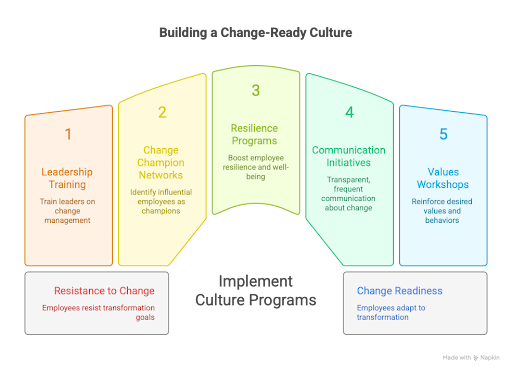
A change-ready culture is never accidental. In my experience, organizations that navigate complex business transformation successfully do so because they treat culture as a deliberate management discipline. The most effective finance leaders invest in structured culture programs that reinforce the “people side” of change alongside systems, data, and processes.
These initiatives directly influence adoption, execution quality, and ultimately the return on your digital financial transformation. Below are several culture programs I have seen materially strengthen change readiness during finance-led transformations.
Leadership Change Training and Alignment
Every transformation succeeds or fails through leadership behavior. That is why leadership change training is one of the highest-ROI investments an organization can make during a finance transformation.
When companies invest in leadership capability often supported by executive leadership consulting or leadership consulting three outcomes consistently follow: resistance drops, momentum builds, and change sustains beyond go-live. Leaders learn how to communicate intent, manage uncertainty, and coach teams through disruption rather than defaulting to authority or silence.
From a CFO’s perspective, this is about execution discipline. Finance managers and project leads who understand change dynamics are far more effective at driving adoption of new financial planning, budgeting & forecasting, or FP&A models.
Alignment at the top matters just as much. If the leadership team fails to be visibly united behind the transformation whether it supports a new finance strategy, a shared services shift, or broader global business services the organization senses it immediately. A leadership group that is aligned, trained, and visibly committed establishes credibility. Without that, even the best management consulting corporate finance program will struggle to gain traction.
Change Champion Networks
One of the most practical tools I have seen is the formal creation of change champion networks. These are influential employees across functions who act as early adopters, issue spotters, and cultural translators for the transformation.
In large organizations, this approach is often supported by business consulting services or a business consultant company to ensure the network is intentional rather than symbolic. Champions help surface operational hassle early, reinforce new behaviors locally, and normalize change through peer influence rather than hierarchy.
I have seen this work effectively in global rollouts, where centralized finance changes risk feelings imposed. When respected employees become ambassadors, communication becomes two-way. Leadership gains unfiltered insight into execution realities, and employees feel represented. The net effect is faster issue resolution and materially higher readiness.
From a governance standpoint, this also minimizes execution risk. Concerns are addressed early.
Employee Resilience and Wellness Programs
Transformation creates pressure, compressed timelines, new tools, evolving roles. Ignoring that reality is costly. Programs that build resilience and adaptability are protective investments in delivery capacity.
Workshops focused on adaptability, stress management, and growth mindset directly support the adoption of new ways of working especially in environments undergoing digital transformation strategy shifts. In one large system implementation I observed, teams that participated in resilience programs showed markedly higher adoption rates and lower attrition during peak transformation periods.
From a finance lens, this matters because burnout erodes productivity precisely when execution discipline is most needed. Supporting employee well-being during transformation preserves capacity, stabilizes delivery, and brings down hidden costs associated with rework and disengagement.
Communication and Storytelling Initiatives
Clear, consistent communication is one of the most underestimated levers in transformation. Culture programs here are less about volume and more about credibility.
Regular town halls, internal updates, and open Q&A forums help replace speculation with clarity. More importantly, storytelling connects change initiatives such as new financial analytics software, financial dashboards, or revised financial planning & analysis processes to the broader corporate strategy and customer impact.
Effective communication is dialog. When leaders listen, acknowledge uncertainty, and visibly incorporate feedback, trust compounds. That trust directly improves execution. In my experience, organizations that communicate the “why” clearly and consistently outperform peers on adoption timelines and benefit realization.
Values and Behavior Workshops
Many finance transformations require behavioral shifts. Greater collaboration across functions, faster decision cycles, and higher accountability often sit at the core of a modern finance strategy.
Structured workshops that reinforce desired values agility, ownership, transparency help translate abstract strategy into daily behavior. When these expectations are clearly articulated and tied to real decisions, people understand how to operate in the new environment.
This is where culture becomes operational.
Bringing It All Together
Each of these programs addresses a different dimension of readiness: leadership alignment, grassroots advocacy, individual resilience, communication discipline, and shared norms. Used together and tailored to your organization’s maturity, they materially increase the odds that a transformation strategy delivers its promised value.
The common thread is simple but often overlooked: successful transformations invest in people as deliberately as they invest in systems. When you do that, change stops feeling like disruption and starts functioning as a shared, managed journey.
From experience, that is where sustainable value is created.
Best Practices for Nurturing a Change-Ready Culture
Beyond individual programs, the organizations that consistently succeed at business transformation apply a set of enduring principles. These best practices embed readiness into daily operations and significantly increase the likelihood that a digital financial transformation delivers measurable results rather than short-lived enthusiasm.
Lead by Example from the Top
Culture always starts with leadership behavior. In my experience, no amount of business strategy consulting or management consulting service can compensate for leaders who say the right things but behave differently.
When the CEO, CFO, and executive team visibly model the behaviors required by the transformation cross-functional collaboration, data-driven decision-making, accountability those behaviors scale rapidly. If a new finance operating model demands tighter integration between FP&A, operations, and commercial teams, leaders must demonstrate that integration themselves.
This is where executive leadership consulting and leadership consulting can play a meaningful role to reinforce how leaders show up under pressure. The companies that outperform are rarely those with the most elegant strategic planning framework; they are the ones with leaders capable of driving change consistently and credibly.
Align Culture with Strategy (and Vice Versa)
One of the most common mistakes I see is treating culture as something to “fix later.” Culture must be designed into the transformation strategy from day one.
Early in the strategic planning process, ask a simple but critical question: which cultural attributes will make this transformation succeed? It might be accountability, speed, customer-centricity, or analytical rigor. Once defined, those attributes must be reinforced through incentives, governance, and decision rights.
At the same time, use the transformation itself to strengthen culture. A redesigned finance workflow, for example, can intentionally break down silos if it is co-created across teams. When corporate strategy, execution, and culture reinforce each other, change stops feeling like a program and starts becoming part of how the business operates.
Communicate the “Why” Relentlessly
Communication during transformation is a perpetual management discipline. Leaders must clearly explain why the transformation matters, how it supports the broader business growth plan, and how it strengthens long-term competitiveness.
From a finance lens, this includes being explicit about outcomes: better financial planning & analysis, more reliable budgeting & forecasting, improved decision quality, and stronger capital allocation. Transparency builds credibility, even when progress is uneven.
Equally important is dialogue. Encourage managers to actively listen and feed insights back into the program. Organizations that maintain open communication consistently outperform peers in adoption and benefit realization.
Empower Employees and Encourage Participation
A truly change-ready culture distributes ownership. Employees who feel trusted and involved execute better.
Practical steps include involving non-managers in design workshops, piloting new processes with frontline teams, or allowing local flexibility in how changes are implemented. This approach aligns closely with modern business management thinking, where adaptability and local problem-solving are strategic advantages.
When people help shape the change, resistance turns into commitment. Over time, this empowerment builds organizational agilitya critical asset in any evolving digital business environment.
Invest in Training and Support
Transformation creates new expectations, and people must be equipped to meet them. Technical training is essential, whether for new finance platforms, financial analytics software, or revised reporting models. But so is capability building around collaboration, communication, and role clarity.
From experience, organizations that invest early in training reduce anxiety, accelerate adoption, and protect productivity. Supporting managers to recognize signs of fatigue or disengagement is equally important. Execution risk often surfaces first at the team level.
Reinforce and Recognize Positive Change
What gets recognized gets repeated. Celebrating milestones, surfacing success stories, and acknowledging constructive feedback reinforces desired behaviors.
Whether it is a team improving financial analysis turnaround time or a function using new insights to influence a growth decision, recognition helps anchor the change. Over time, these reinforcements shape a new identity: a company that adapts, learns, and executes.
Measure and Monitor Readiness Continuously
Change readiness must be treated like any other performance metric, measure it, monitor it, and intervene early.
Pulse surveys, readiness assessments, and feedback loops help identify troubles before it becomes failure. This is disciplined strategic management applied to people.
Monitoring readiness protects momentum and prevents small issues from eroding confidence. Transformation is a journey and sustained value requires sustained attention.
Conclusion: Putting People at the Heart of Financial Transformation
A successful financial transformation is defined by adoption, durability, and outcomes. The deciding factor is always people.
When change readiness and culture are strong, transformations deliver ROI, strengthen corporate strategy, and support sustainable performance. When they are weak, even well-funded initiatives underperform.
The lesson is straightforward: invest in readiness as deliberately as you invest in technology. Build capability, communicate with clarity, and lead with consistency. These efforts may feel secondary when budgets and timelines are tight, but they are precisely what separates transformation theater from real value creation.
Before your next major finance initiative, take an honest look at your cultural landscape. Are leaders aligned? Are teams ready to learn and adapt? Are you managing readiness with the same rigor as cost, scope, and timelines? If you think you are fumbling to answer any of these questions, book a call with me today and let me take care of it.
Making culture and readiness a formal workstream alongside technology and process is one of the most effective risk mitigations available to a CFO.
Ultimately, financial transformation is as much about mindset as it is about balance sheets. Organizations that master both do not just complete transformations; they build enduring adaptability. In today’s environment, that capability may be the most valuable asset of all.
FAQ: Frequently Asked Questions
Q1: What is change readiness in the context of business transformation?
A: In practical terms, change readiness is an organization’s capacity to absorb and sustain change without losing momentum or value. In the context of business transformation, it reflects whether people, processes, and culture are prepared to operate in new ways, often under pressure and uncertainty.
High change readiness shows up when employees understand the intent behind the change, have the skills required to execute it, and trust leadership’s direction. From a finance perspective, it signals that investments in digital financial transformation, financial planning, or new FP&A models are likely to deliver returns rather than stall at adoption.
Low readiness tends to surface as confusion, resistance, or capability gaps. Those are early warning signs that a transformation may face delays, cost overruns, or diluted impact. Simply put, change readiness measures how equipped and how willing your organization is for what is coming next.
Q2: How does organizational culture impact financial transformation success?
A: Culture is one of the most decisive factors in any financial transformation. It shapes how people respond when systems change, roles evolve, and expectations rise.
A culture that values learning, transparency, and collaboration accelerates adoption of new tools whether that is enhanced financial analysis, modern budgeting & forecasting, or advanced financial planning & analysis capabilities. A culture defined by silos or blame, on the other hand, tends to slow execution and erode confidence.
From experience, trust in leadership and openness to change determine whether a transformation strategy gains traction or stalls. Culture can amplify the impact of a well-designed finance strategy, or quietly undermine it even when the technology and processes are sound.
Q3: What are some examples of culture programs that support change management?
A: Effective culture programs focus on shaping behavior. Common examples I have seen work well include:
- Change champion programs, where respected employees act as local advocates, provide feedback, and support adoption across teams
- Training and development initiatives, often supported by leadership consulting, that equip managers to lead through change and help employees build resilience
- Engagement and communication programs, such as town halls or internal updates that connect the transformation to the broader corporate strategy
- Recognition programs that reinforce desired behaviors, such as cross-functional collaboration or disciplined use of new finance tools
- Values alignment workshops, which reconnect organizational values to the transformation’s objectives and day-to-day decision-making
These initiatives reduce disturbance by addressing employees’ need for clarity, capability, and confidence critical ingredients for sustained change.
Q4: How can we measure or assess our organization’s change readiness?
A: Measuring change readiness requires both data and judgment. Many organizations begin with formal readiness assessments, surveys or interviews that evaluate leadership alignment, employee sentiment, skill gaps, and prior change experience.
From a finance standpoint, indirect indicators also matter. Elevated turnover, declining engagement, or persistent issues in execution can signal readiness challenges. The key is to establish a baseline and track progress over time, much like any other performance metric.
Organizations that treat readiness as part of ongoing strategic management are better positioned to intervene early and protect the value of their transformation investments.
Q5: Why do financial transformation projects need a focus on change readiness and culture?
A: Financial transformation projects introduce new technologies, redesigned processes, and often new operating models. Without a focus on change readiness and culture, these initiatives encounter predictable risks: low adoption, resistance, and execution drag.
From a CFO’s lens, this is about risk management and value realization. Investments in digital business capabilities, modern financial analytics software, or enhanced FP&A only create value when people use them effectively.
Focusing on readiness ensures that teams are brought along. It mitigates downside risks such as delays or underutilized systems and maximizes upside by enabling employees to find better ways of working.
Ultimately, transformation success is measured by sustained business outcomes. Those outcomes materialize when change becomes routine and culture supports continuous improvement.
Ignoring readiness is like building on unstable ground. You may see early progress, but it will not hold under pressure. Investing in culture and readiness builds the foundation for durable performance and long-term competitiveness exactly what finance leaders are accountable for delivering.